Chapter 10 - The Door That Stayed OpenOne year later, snow fell again on Christmas Eve.
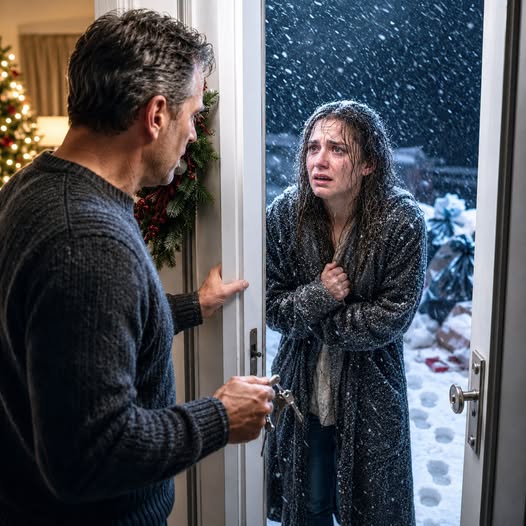
Not as violently as before.
Softly this time.
Kindly, almost.
It settled over the porch railing, the old maple trees, and the driveway where Emily had once stood trembling with Lily hidden inside her coat. For months, I could not look at that porch without seeing bloodless lips and fear. But memory changes when love returns to the place where terror once stood.
That evening, warm light filled the house.
Emily sat on the living room floor helping Lily stack wooden blocks. Lily was no longer the fragile, shivering newborn I had wrapped in towels. She was round-cheeked, loud, curious, and deeply offended whenever gravity ruined her architecture.
Every time the blocks fell, she looked personally betrayed.
Emily laughed more now.
Not constantly. Not easily.
But honestly.
That mattered.
Healing had not arrived like a sunrise. It came in difficult pieces. Court dates. Therapy appointments. Nightmares. Pediatric visits. Phone calls with prosecutors. Quiet mornings where Emily could not stop shaking and afternoons where she suddenly realized she had gone three hours without thinking about Ryan.
She did not “move on.”
I had grown to hate that phrase.
People move on from delayed flights and bad haircuts.
They survive betrayal.
They rebuild after abuse.
They learn which rooms inside themselves are still safe.
Emily had spent the year doing exactly that.
Ryan pled guilty to forgery and attempted custodial interference after Victor Lane agreed to cooperate with prosecutors. The child endangerment charge remained contested longer, but the nursery footage did what truth often does when it is finally allowed into a room. It stayed. It did not blink. It did not soften itself for anyone’s reputation.
Ryan received prison time, probation conditions, and a permanent custody restriction that barred him from unsupervised contact unless a future court found extraordinary change.
Emily did not attend his sentencing.
She wrote a victim statement instead.
Nora read it aloud.
I remember one line most clearly:
You tried to make me look unstable because I cried. I cried because I still had a conscience. That is something this court cannot sentence you to grow.
Margaret fought harder.
She claimed misunderstanding, emotional distress, grandmotherly panic, medication confusion, and finally, betrayal by her own son. None of it survived the evidence. Vanessa testified. Victor testified. The recordings testified. Margaret received her own sentence and, perhaps worse for a woman like her, public disgrace.
Her society friends stopped calling.
Her charities removed her name.
Her pearls did not help.
Vanessa moved away after giving her statements. Emily never forgave her, but she stopped hating her. “Hating Vanessa takes energy she doesn’t deserve,” she told me once.
That was the day I knew my daughter was returning to herself.
As for the Carter residence, the trust took possession after the court approved the eviction. Emily never stepped inside again. She asked Nora to have professionals pack anything worth keeping. Most of what came back fit into six boxes.
Baby photos.
Her mother’s necklace.
A few books.
A mug she loved.
Everything else, she let go.
“The house was never home,” she said.
Then she stayed with me.
At first, she called it temporary.
Then Lily took her first steps between my kitchen and the hallway, and Emily cried so hard she had to sit down.
After that, nobody mentioned leaving for a while.
Northstar changed too.
I had planned to remain quiet until death turned me into a paragraph in a business magazine. But Emily’s video had changed something I had not expected. Messages came from women across the country. Employees. Drivers’ wives. Dispatchers. Managers. Strangers. People who had survived in silence because silence seemed safer than being called unstable.
Emily read them all.
Then one morning, she walked into my study with Lily on her hip and said, “We should do something.”
That became The Open Door Fund.
Emergency housing. Legal assistance. Transportation. Childcare support. Quiet exits for women who needed one safe night before they could imagine a safe life.
Emily refused to put her face on billboards.
But she ran the program.
And she ran it well.
My daughter, who had been called fragile by people who feared her strength, built something stronger than revenge.
She built escape routes.
On that second Christmas Eve, the house was full.
Nora was in the kitchen arguing with Marianne over whether gingerbread needed molasses. Caleb stood outside pretending to inspect security lights while sneaking cookies from a napkin. Dr. Harlan bounced Lily on one knee and looked absurdly proud when she tried to say “doctor” and produced “dock-dock” instead.
Emily stood by the fireplace watching all of it.
I joined her.
“You okay?” I asked.
She smiled faintly. “I think so.”
“You don’t have to be.”
“I know.”
That was new too.
For years, Emily had believed love required performance. Smiling at dinners. Answering gently. Keeping peace. Making excuses. Shrinking so others could feel large.
Now she knew love could handle the truth.
Even messy truth.
Especially messy truth.
Snow tapped softly against the windows.
Emily looked toward the front door.
“I heard her again last night,” she said.
“Who?”
“Myself.” Her voice softened. “On the porch. Asking you to open the door.”
I felt my throat tighten.
“I hear it too sometimes.”
She looked at me. “I used to feel ashamed when I remembered it.”
“You were saving your child.”
“I know that now.”
Lily toddled toward us then, one sock half-off, carrying a wooden block in each hand like urgent legal documents.
Emily bent down. “Hi, baby.”
Lily slapped a block into my palm.
“Thank you,” I said solemnly.
She gave me the second one too.
Emily laughed.
I looked at them — my daughter alive, my granddaughter warm, my house no longer quiet with grief — and thought of Carol.
My wife would have loved this child fiercely.
She would have stood in the doorway that night with a blanket before I even moved. She would have known exactly what to say to Emily. She would have made tea, called Nora, and then calmly destroyed Ryan Carter before breakfast.
I missed her so much in that moment that it hurt to breathe.
Emily touched my arm.
“She’d be proud of you,” she said.
I looked at her.
“No,” I said. “She’d be proud of you.”
The doorbell rang.
The room went still.
Old fear moves fast.
Caleb appeared from nowhere.
Nora set down a tray in the kitchen.
Emily picked up Lily.
I checked the monitor.
A delivery driver stood on the porch holding a box wrapped in brown paper, stamping his boots against the cold.
I opened the door.
“Package for Emily Hale?” he said.
Emily Hale.
After the divorce finalized, she had taken her name back.
Not because Ryan had ruined Carter.
Because Hale had always been hers.
She signed for the package and brought it inside.
No return address.
Caleb inspected it before allowing her to open it.
Inside was a small handmade blanket.
Cream-colored.
Soft.
Folded around a note.
Emily read it silently.
Then she handed it to me.
The note said:
Mrs. Hale,
You don’t know me. Last Christmas, I saw your video while sitting in my car with my son because I was afraid to go back inside. You said a mother protecting her child is not unstable. That sentence saved us. We are safe now because your fund helped us leave. I made this for your daughter because your door opened for more than one baby that night.
Merry Christmas.
Emily pressed the blanket against her mouth and cried.
This time, nobody feared her tears.
Nora cried too.
Marianne pretended not to.
Caleb walked outside for no reason at all.
I looked at Lily, who had no idea why the adults were falling apart over fabric and paper. She only reached for the blanket because it was soft.
Emily wrapped it around her.
Then she looked at the front door.
The same door she had begged me to open.
The same door Ryan thought marked the end of her options.
The same door that had become the beginning of everything.
“Dad,” she said quietly.
“Yes?”
“Thank you for opening it.”
I looked at my daughter, then at my granddaughter warm in her arms.
“I’ll always open it.”
Outside, snow kept falling.
Inside, Lily laughed.
And for the first time in a year, Christmas Eve felt not like the night my family was nearly destroyed, but the night the wrong people made the worst mistake of their lives.
They threw my daughter into the cold.
They thought no one would answer.
They forgot one thing.
Some doors do not just open.
May you like

Some doors start wars.
And ours had ended with my girls safe, my enemies exposed, and a house full of light that no storm could touch.