Chapter 1: My Brother Left His Daughter in a Hospital Bed for a Vacation
Chapter 1: My Brother Left His Daughter in a Hospital Bed for a Vacation
The first thing I noticed was that my brother did not look scared.
He looked annoyed.
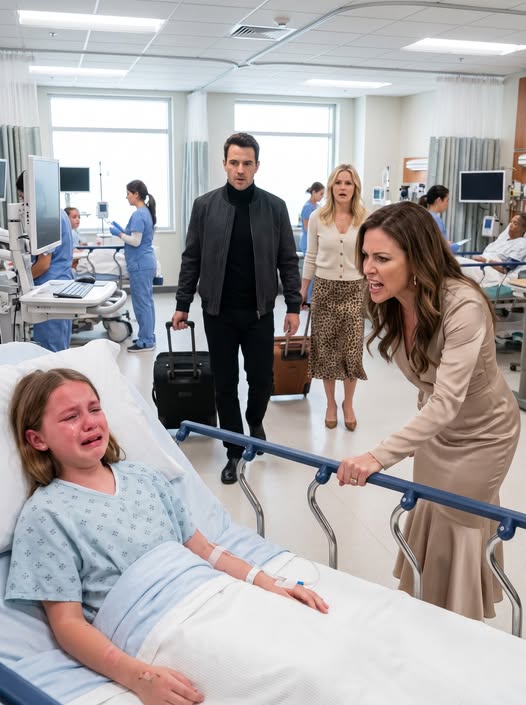
Daniel Carter stood in the recovery ward of St. Mary’s Medical Center in Portland with one hand in his pocket and the other wrapped around his phone, checking the time every few minutes as if the hospital staff were personally trying to ruin his vacation.
Behind him, his wife, Melissa, waited near the wall with a designer suitcase beside her ankles.
A hospital suitcase would have been normal. A bag with pajamas, slippers, clean clothes, maybe Emma’s favorite stuffed animal.
But Melissa’s suitcase was not for the hospital.
It was glossy, expensive, and tagged for Maui.
Their two younger children, Owen and Lily, stood near the elevators whispering excitedly about beaches, pools, and snorkeling. Lily had a pink backpack shaped like a seashell. Owen kept asking whether the hotel had unlimited pancakes.
Everyone in that hallway was thinking about sunshine.
Everyone except Emma.
My ten-year-old niece lay in a hospital bed under a thin white blanket, pale from anesthesia, with an IV taped to her small arm. Her dark hair stuck damply to her forehead. Every few breaths, her face tightened with pain she was too exhausted to explain.
Only hours earlier, surgeons had removed her ruptured appendix.
The operation had gone well, but the surgeon had been clear. Emma’s recovery would not be simple. She needed antibiotics on schedule. She needed help walking. She needed her temperature monitored. She needed someone to watch for infection, make sure she ate, and help her move carefully so her incision did not pull.
Most of all, she needed her parents.
Daniel looked at me.
“Our flight leaves in three hours.”
For a second, I thought I had misunderstood him.
I stared at him, waiting for the rest of the sentence.
Something like, So we already canceled it.
Or, I don’t know what to do about the tickets.
Or even, I feel terrible, Maya, but I need help figuring this out.
But Daniel only checked his watch again.
I said, “Then cancel it.”
Melissa made a small sound, half laugh and half sigh.
“We’ve planned this vacation for eight months.”
I looked at her suitcase, then at the child in the bed.
“Emma had emergency surgery.”
Melissa folded her arms.
“The trip is completely non-refundable.”
As if money could outweigh a frightened little girl waking up in a hospital bed.
As if a resort deposit mattered more than a ruptured organ.
Daniel lowered his voice, the way he always did when he wanted to sound reasonable while saying something selfish.
“Maya, don’t turn this into unnecessary drama.”
A nurse standing near Emma’s monitor looked from him to me, then quickly looked away. She had probably seen enough families to know when silence was safer than honesty.
Then Emma stirred.
Her eyelids fluttered open.
“Dad?” she whispered.
Daniel’s face changed instantly.
Not into concern.
Into performance.
He stepped closer and patted her shoulder.
“You’re okay, sweetheart. Everything went fine.”
Emma blinked slowly, still trapped between medication and pain.
“Are we going home?”
Daniel hesitated just long enough for my stomach to drop.
Melissa moved closer.
“Not today, honey. Aunt Maya is here.”
Emma’s eyes shifted to me.
I tried to smile for her.
She looked back at Daniel.
“You’re leaving?”
No one answered quickly.
That was the answer.
Daniel rubbed the back of his neck.
“We’ll only be gone a week.”
Melissa added, “You probably won’t even notice. You’ll be resting most of the time.”
Emma did not cry.
That hurt worse than crying.
Her face simply changed.
The little bit of hope in her eyes disappeared, quietly and completely, like someone had turned off a light.
I stepped away from the bed and faced my brother.
“I came because you said Emma was scared,” I said. “I never agreed to become her parent while you went on vacation.”
Daniel’s jaw tightened.
“She’s family. You’re her aunt.”
“And you’re her father.”
The words hung between us.
For a moment, I thought maybe shame would reach him.
It didn’t.
He looked toward the hallway, where Owen and Lily were getting restless.
“Look, we already talked to discharge coordination. They said you can be listed as the responsible adult for her care.”
I stared at him.
“You already arranged this?”
Melissa lifted her chin.
“It’s temporary.”
Temporary.
That was the first lie.
A hospital administrator arrived with a clipboard and several forms. Daniel took the pen before anyone could say another word. He signed quickly, barely reading. Authorization for medical decisions. Temporary care instructions. Emergency contact updates. Medication acknowledgment.
Each signature made my chest feel tighter.
Emma watched him from the bed.
Her father signed away his responsibility with the same impatience he used when signing restaurant checks.
When the nurse reviewed the medication schedule, Daniel nodded without listening.
Melissa looked at her phone.
Owen asked if they would miss the flight.
Lily complained that the hospital smelled weird.
Emma closed her eyes.
I stood beside her bed and listened to everything.
Antibiotics every eight hours.
Pain medication as needed but carefully spaced.
Watch for fever.
No stairs without help.
No heavy lifting.
Follow-up appointment in one week.
Call immediately if vomiting, swelling, redness, confusion, or severe pain developed.
When the nurse finished, she looked at Daniel.
“Do you understand these instructions?”
Daniel glanced at me.
“Maya has it.”
The nurse did not smile.
“She needs a responsible adult monitoring her closely.”
“I know,” he said.
But he was already halfway gone.
Melissa leaned down and kissed Emma’s forehead.
It was a quick kiss.
Clean.
Careful.
The kind of kiss a person gives when they do not want hospital germs on their lipstick.
“We love you,” Melissa said.
Emma opened her eyes.
“Can you stay until I fall asleep?”
Melissa froze.
Daniel checked his watch again.
“Maui flight,” Owen whispered from the hallway.
Daniel forced a smile.
“Aunt Maya will stay with you.”
Emma looked at him.
“But I asked you.”
For the first time, Daniel looked uncomfortable.
Not enough to stay.
Only enough to resent being asked.
“I’ll call you from the hotel,” he said.
Emma’s lips pressed together.
“Okay.”
That one word was so small I almost missed it.
Then Daniel picked up Melissa’s suitcase.
He leaned over Emma, kissed her forehead, and said, “Be good.”
Not get better.
Not I’m sorry.
Not I’ll be right back.
Be good.
Then they left.
The elevator doors opened.
Owen and Lily ran in first.
Melissa followed, pulling her suitcase behind her.
Daniel stood outside the elevator for one final second, looking back at us. For a heartbeat, I thought he might change his mind.
Instead, he lifted one hand in a quick wave.
Then the elevator doors closed.
Emma turned her face toward the wall.
I waited until I knew she was crying silently before I sat down beside her.
“You don’t have to pretend with me,” I whispered.
Her shoulders shook once.
“I didn’t mean to ruin their trip.”
My heart broke so sharply I had to look away.
“You did not ruin anything.”
“They waited a long time for it.”
“You had emergency surgery.”
She swallowed hard.
“Melissa said I always need attention at the worst times.”
I went still.
“What?”
Emma’s eyes widened, as if she had accidentally said something forbidden.
“Nothing.”
But it was not nothing.
Children learn early which truths make adults angry.
That night, I slept in a vinyl chair beside her bed.
Or tried to.
Every time Emma moved, I woke up. Every time the machine beeped, my body tensed. Every time a nurse came in, I stood and listened. I wrote down medication times on a notepad because I was terrified of missing something.
At 2:10 a.m., Emma woke up nauseous.
I held the basin while she cried and apologized between dry heaves.
“I’m sorry,” she whispered. “I’m sorry, Aunt Maya.”
“You have nothing to apologize for.”
“I’m making you stay here.”
“No,” I said, brushing her hair back from her face. “I am choosing to stay.”
She looked at me like she did not understand the difference.
That was when I began to understand how long she had been learning to feel like a burden.
The next day, Daniel sent a photo.
A beach.
Blue water.
Palm trees.
The message said: She doing okay?
Not How is Emma feeling?
Not Tell her I love her.
Just She doing okay?
I looked at Emma asleep in the bed, pale and fragile, one hand resting near her bandaged abdomen.
Then I typed back: She is in pain. Fever is down. Doctor wants another night of monitoring.
Daniel replied with a thumbs-up emoji.
I stared at it until my vision blurred.
For four nights, I stayed in that hospital room.
I learned the difference between normal post-surgical pain and pain that made the nurse come quickly. I learned how to help Emma sit up without pulling her incision. I learned that she liked ice chips better than water. I learned that she was embarrassed when she needed help walking to the bathroom.
Every time she needed something, she apologized.
Sorry I’m slow.
Sorry I dropped it.
Sorry I woke you up.
Sorry I’m not better yet.
Each apology felt like evidence of something I did not yet know how to name.
On the fifth day, the doctor finally approved discharge.
Emma looked both relieved and terrified.
“Are they coming?” she asked.
I checked my phone.
Daniel had texted twenty minutes earlier.
Can’t fly back early. Just take her to your place until Sunday. We’ll pick her up then. Thanks.
Thanks.
As if I had watered his plants.
As if I had picked up his dry cleaning.
As if I had not just held his daughter through the worst pain of her young life while he watched sunsets from a luxury resort.
I looked at Emma and forced my voice to stay gentle.
“You’re going to come home with me for a few days.”
Her expression did not change much.
She had already expected disappointment.
That was the worst part.
At my house, I set up the guest room with extra pillows and a small table for her medicine. I bought soup, crackers, ginger ale, children’s books, loose pajamas, and a thermometer that beeped softly.
Emma kept thanking me.
For the soup.
For the clean sheets.
For helping her shower.
For not being mad when she cried because the incision hurt.
On Sunday morning, she woke up early.
She brushed her hair carefully.
She asked if she should pack her things.
I told her we would wait for Daniel’s call.
No call came.
At noon, I texted him.
What time are you picking Emma up?
Three hours passed.
Then Daniel replied.
Work emergency. Tomorrow is better.
Emma was sitting on the couch when I read it.
She knew before I said anything.
Her face did that quiet shutting-down again.
“He’s not coming?”
I sat beside her.
“Not today.”
She nodded.
“Okay.”
I hated that word.
Monday came.
Melissa had a migraine.
Tuesday came.
Owen had soccer.
Friday came.
Daniel said the house was “too chaotic” and Emma should stay where she was “until things settled.”
Things settled.
Weeks passed.
Then a month.
Then another.
Emma’s scar healed on the outside.
But other things did not.
She flinched when my phone rang late at night. She asked permission before opening the fridge. She hid pain until it became obvious. She panicked if she thought she had made me late.
I enrolled her in remote assignments through her school. I drove her to follow-up appointments. I filled prescriptions. I kept every receipt because medical bills confused me and insurance required proof.
At first, I was not collecting evidence.
I was simply trying to stay organized.
But Daniel kept texting excuses.
Can’t this weekend.
Melissa thinks Emma needs consistency right now.
Maybe next week.
Tell her we miss her.
Tell her we’ll call later.
They rarely called.
When they did, Emma became quiet afterward.
One evening, after a call that lasted less than three minutes, I found her sitting on the bathroom floor.
“Sweetheart?”
She wiped her face quickly.
“I’m okay.”
“You don’t have to be okay.”
She looked at me.
“If I’m not okay, do I have to leave?”
I knelt in front of her.
“No.”
“Even if I cry?”
“Especially then.”
She stared at me for a long time.
Then she whispered, “Dad doesn’t like crying.”
That night, after Emma fell asleep, I opened the folder where I kept her medical papers.
Hospital discharge instructions.
Prescription records.
School emails.
Appointment notes.
Screenshots of Daniel’s texts.
A timeline began forming in my head before I admitted what it was.
By the fifth month, Emma was living with me full-time in every way that mattered.
Except legally.
Daniel still called himself her father.
Melissa still posted family photos from brunch, birthdays, and weekend trips.
Emma was never in them.
One rainy Thursday morning, I sat in a family courtroom in Multnomah County while a judge reviewed the records.
Daniel had received notice.
He had not appeared.
Later he would claim he thought it was routine paperwork.
But the judge did not decide based on Daniel’s excuses.
She looked at the hospital forms he had signed. The discharge notes. The missed pickup texts. The school attendance reports. The medical follow-up records. The counselor’s preliminary statement.
At 11:48 a.m., Judge Holloway signed a temporary guardianship order.
Just like that, the truth became official.
Emma would remain with me.
Daniel’s contact would be limited.
The court would review his fitness as a parent.
Within minutes, my phone began ringing.
Daniel.
Then Daniel again.
Then Melissa.
Then Daniel.
Seventeen calls before I finally answered.
I was parked outside Emma’s elementary school, watching children stream through the front entrance with backpacks bouncing behind them.
Emma walked more slowly than most.
Sometimes she still rested one hand against the right side of her abdomen when she was tired.
But she was smiling at a girl from her class.
She looked safe.
Not fully healed.
But safe.
I answered the phone and said nothing.
Daniel shouted first.
“What did you do?”
I watched Emma disappear through the school doors.
Then I replied calmly, “Lower your voice.”
“You went behind my back and took me to court?”
“You received notice.”
“I thought it was routine paperwork.”
“It was a custody hearing.”
“You had no right.”
I closed my eyes for one second.
“You left your daughter recovering from emergency surgery and boarded a plane to Hawaii.”
His voice sharpened.
“You keep saying that like we abandoned her.”
I opened my eyes.
“You didn’t leave her in an alley, Daniel.”
The school doors closed behind Emma.
“You left her in a hospital.”
Silence filled the line.
Then Melissa’s voice appeared. He had put me on speaker.
“Maya,” she said, trembling with anger, “this temporary guardianship is humiliating.”
I looked toward the school entrance.
“That’s what you’re worried about?”
“We are her parents.”
“No,” I said quietly. “You are the adults who left.”
Daniel breathed hard into the phone.
Then I said the sentence that finally made him stop.
“Emma told the court-appointed counselor she was afraid that if she ever got sick again, you would leave her another time.”
Everything went quiet.
For several seconds, no one spoke.
Then Daniel whispered, “She actually said that?”
I looked at the school where his daughter was trying to learn how to feel safe again.
“Yes,” I said.
“She did.”
And hearing those words hurt far more than any court order ever could.
Because Daniel had lost something that morning.
Not custody.
Not control.
Something worse.
May you like

His daughter’s belief that he would stay.
And he was about to discover that no judge in the world could simply order that back.