Chapter 10 - The Wedding That Became a ReckoningThomas Reed did not look like a man afraid of police.
That was the first thing I noticed.
He walked through the ballroom slowly, letting cameras turn toward him, letting whispers gather, letting old allies and enemies remember exactly who he had been. For twenty years, he had controlled permits, zoning delays, redevelopment grants, public-private contracts, and the quiet doors through which fortunes entered cities.
Retired men like that did not lose power.
They simply stopped signing documents in public.
My father stepped in front of me.
Reed smiled at him. “Daniel. This is unfortunate.”
Dad’s voice was flat. “You should not have come.”
“I came to prevent a misunderstanding.”
Mara said, “Commissioner Reed, this is an active investigation.”
He glanced at her. “Former commissioner.”
“Current suspect,” Evelyn Hart said.
Reed’s eyes moved to her. Something cold flickered in them.
“Mrs. Hart. Still chasing ghosts?”
“My husband was not a ghost when your friends destroyed him.”
Reed sighed, as though disappointed by poor manners. Then he turned back to my father.
“This can still be contained,” he said. “The Mercers became greedy. That is regrettable. But no one benefits from tearing open old agreements.”
My father laughed quietly.
“My daughter was nearly trapped into a violent marriage so you could bury old crimes.”
Reed looked at me then.
Not with anger.
With assessment.
Like I was a damaged building he was deciding whether to demolish.
“You are young,” he said. “You think exposure is justice. It is not. Exposure is fire. It burns guilty and innocent people alike.”
I stepped out from behind my father.
“I’m willing to risk the guilty being uncomfortable.”
A few guests murmured.
Reed smiled. “You have your mother’s mouth.”
My father moved so suddenly that two officers stepped closer.
“Do not speak about my wife.”
Reed lifted a hand. “I meant it as a compliment.”
“No,” Dad said. “You meant it as a warning.”
The federal agent approached Reed. “Sir, we need you to remain on site.”
Reed smiled. “Am I being detained?”
“For the moment, yes.”
The ballroom shifted.
For the first time, Reed’s confidence cracked.
Only a line near his mouth. Only a flash in his eyes.
But I saw it.
So did Mara.
So did my father.
Reed’s gaze moved across the room, calculating exits, cameras, witnesses, weak points. Then he looked toward Richard Mercer.
Richard would not meet his eyes.
That was when Reed understood.
The Mercers had become liabilities.
And he had walked into the room to control a fire that had already reached the walls.
The federal agent continued. “Your voice may be connected to calls placed to a device recovered in the unauthorized monitoring room.”
Reed chuckled. “May be connected.”
Mara opened her folder again. “There are also references to you in the Alder Bridge files.”
His eyes flickered.
She held up a page. “Including correspondence about Vale Construction, Hart Family Investments, and bid manipulation.”
Reed looked at my father. “You kept copies.”
Dad shook his head. “No. They did.”
He pointed at Richard and Celeste.
“They trusted each other so little that everyone kept blackmail.”
That was the beautiful rot at the center of all of them.
They had built an empire on secrets, but none of them believed anyone else deserved loyalty. They kept insurance. Copies. Recordings. Hidden ledgers. And when the structure finally cracked, their own fear became our evidence.
Reed turned toward me.
“You did this.”
“No,” I said. “I found it.”
His smile vanished.
Detective Harris received a call, listened, and then looked at the federal agent.
“We have confirmation,” she said. “Voice match is strong enough for probable cause. Additional warrants are being prepared.”
Reed’s jaw tightened.
The cameras caught it.
Every second.
The man who had walked in untouchable was being made visible.
And powerful men hated visibility more than prison.
Nolan shouted from near the aisle, “Tell them, Reed! Tell them what you promised my mother!”
Reed looked at him with pure contempt.
“You were never supposed to improvise.”
Nolan laughed bitterly. “There it is.”
Celeste, now held near the side doors, went very still.
Richard cursed.
The federal agent turned toward Reed. “Sir, place your hands where we can see them.”
Reed did not move.
For one dangerous moment, the room seemed to hold its breath around him.
Then Evelyn Hart stepped forward.
Not the police. Not my father. Not me.
Evelyn.
She held the old photograph of her husband that had been found in the monitoring room. Her hand trembled, but her voice did not.
“My husband died believing men like you always win,” she said. “I wish he had lived long enough to see you in this room.”
Reed’s face tightened.
Evelyn stepped closer. “But I did. And I will remember it for both of us.”
Something in the ballroom changed then.
This was no longer my ruined wedding.
It was a reckoning.
For Rachel’s fear. Lydia’s silence. Evelyn’s loss. My father’s guilt. My mother’s memory. Every employee cheated by fake contractors. Every woman paid to disappear. Every family threatened because someone powerful wanted another signature.
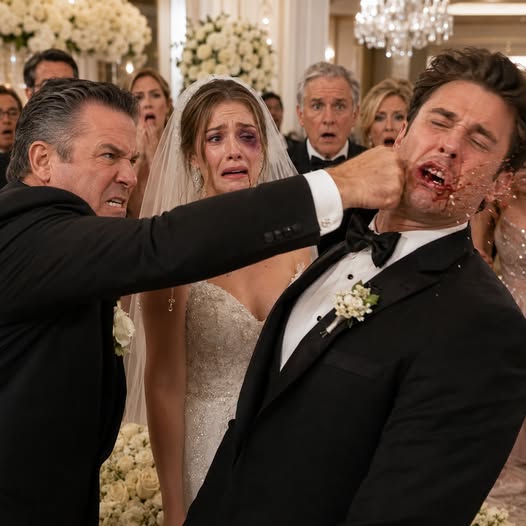
The agent cuffed Thomas Reed beneath the chandeliers.
No one clapped.
It would have felt too small.
Instead, the room stood in silence as he was led past the broken champagne glass, past the fallen flowers, past the altar where I had almost promised my life to a man who saw marriage as ownership.
When Reed passed me, he leaned slightly and whispered, “This will follow you forever.”
I looked at him.
“No,” I said. “It will follow you.”
His eyes narrowed.
Then he was gone.
By sunset, the wedding venue was surrounded by news vans.
By midnight, Mercer Holdings’ board suspended Nolan, Richard, and Celeste.
By morning, three banks froze related accounts.
Within a week, investigators uncovered a network of fraudulent contractors, bribed officials, forged guarantees, and intimidation payments stretching back nearly two decades.
The story spread everywhere.
Not because I wanted fame.
Because people recognized the room.
Maybe not the chandeliers or the billion-dollar contracts.
But the silence.
The way families call cruelty private.
The way powerful people call fear tradition.
The way women are told to smile through pain because the guests are already seated.
At first, headlines called me the Runaway Bride.
Then the Fraud Bride.
Then the Woman Who Ended the Mercers.
I hated all of them.
I was not a symbol when I woke up shaking at 3 a.m.
I was not fearless when I saw Nolan’s face in dreams.
I was not strong every time I had to repeat what happened for lawyers, doctors, investigators, and strangers who wanted the clean version.
But I was free.
That mattered more.
Months later, Nolan pleaded guilty to reduced charges after turning over evidence against his parents and Reed. He tried to write me a letter from jail. I never opened it.
Celeste fought longer. Women like her always believed delay was the same as innocence. But recordings, financial trails, witness testimony, and her own hidden files buried her polished lies one by one.
Richard Mercer lost his company before he lost his freedom.
Thomas Reed lost the city that had once feared him.
My father testified for three days.
On the last day, he spoke about my mother.
He told the court how she had refused to let him surrender Vale Construction during her illness. How she believed buildings mattered only if the people inside them were safe. How he had made mistakes trying to protect the company, but the Mercers had turned emergency into leverage and grief into a weapon.
When he stepped down, he found me in the hallway and took my hands.
“I used to think protecting you meant standing between you and danger,” he said.
I squeezed his fingers.
“Sometimes it means standing beside me after I name it.”
He nodded, crying quietly.
A year after the wedding that never happened, I returned to the same venue.
Not for revenge.
For a fundraiser.
Vale Construction had converted three stalled Mercer luxury projects into transitional housing and legal support centers for survivors of domestic violence and financial coercion. Evelyn Hart chaired the oversight board. Lydia ran compliance. Rachel created a scholarship fund for families threatened into silence.
My father hated the venue, but he came anyway.
He stood beside me beneath the chandeliers, looking at the repaired marble floor where Celeste’s champagne glass had shattered.
“You okay?” he asked.
I looked around.
No white roses this time.
No altar.
No groom waiting with ownership in his eyes.
Just tables full of people who had survived something and refused to stay ashamed.
“I am,” I said.
And I meant it.
Near the end of the evening, Rachel raised a glass.
“To Elena,” she said. “Who turned a wedding into a warning.”
I shook my head, smiling.
“No,” I said. “To everyone who finally stopped whispering.”
The room lifted their glasses.
My father put his arm around my shoulders.
For the first time in a long time, I did not flinch when someone touched me.
Outside, the city lights glowed against the windows. Buildings my father had raised stood in the distance, stronger than the men who had tried to steal them. Somewhere beyond them was the house where I now lived alone, with new locks, quiet mornings, and no one asking why I needed both.
I had once thought my wedding day was the day my life would begin.
I was wrong.
It was the day the lie ended.
And sometimes, the end of a lie is the first real vow a woman ever makes to herself.
Never again.
Not in my house.
May you like
Not in my family.
Not in my name.