Chapter 7 - THE ACCIDENT THAT WASN’T SIMPLECaleb’s accident report arrived two days later.
Samuel Pike brought it to the hospital with a face so grim I knew before he spoke.
“I don’t want to alarm you,” he said.
Marcus gave him a hard look. “That sentence never helps.”
Samuel placed the report on the table.
Caleb’s death had been officially ruled an accident. A commercial truck ran a red light on Route 17 and struck Caleb’s car on the driver’s side. The trucking company settled quickly with Caleb’s estate, which explained the sudden increase in Lily’s trust.
I scanned the pages.
No alcohol.
No party.
No reckless driving.
Everything my mother told me had been false.
But Samuel had highlighted one section.
Witness statement: unidentified female seen arguing with victim in parking lot approximately twenty minutes prior to collision.
My skin prickled.
“Female?” I asked.
Samuel nodded. “The witness described a woman in a red coat.”
Vanessa owned a red coat.
I hated that my mind went there immediately.
I hated more that it fit.
Detective Collins took the report and reopened questions around Caleb’s last known contacts. Phone records showed three calls from Vanessa to Caleb the day he died. One at 4:12 p.m. One at 5:03 p.m. One at 6:28 p.m.
The crash happened at 6:56 p.m.
Vanessa had told me she barely knew Caleb.
“She said he was trash,” I told the detective. “She said he used me.”
Detective Collins wrote it down.
By then, Lily had been discharged. Marcus took us to his house because returning to my parents’ house was impossible and my apartment lease had ended during the week we stayed there.
His house was small but warm, with a front porch, a kitchen that smelled like coffee, and a spare room he had already painted pale yellow months earlier.
He had called it “just in case Lily ever wanted sleepovers.”
Now it became her room.
The first night, Lily refused to sleep unless every closet door was open and every trash can was outside the house.
So Marcus removed them.
All of them.
Bathroom trash can. Kitchen trash can. Office wastebasket.
He carried them to the garage without making Lily feel silly for asking.
When he came back, she whispered, “You’re a good grown-up.”
He crouched beside her bed. “I’m trying.”
“No,” she said sleepily. “You are.”
I cried in the hallway where neither of them could see.
The next morning, Detective Collins called.
“We found the original phone,” she said.
“What phone?”
“Caleb Reeves’s old phone. It was in your father’s storage unit.”
I sat down hard on the couch.
“My father had Caleb’s phone?”
“Yes.”
The storage unit had been rented under Vanessa’s name but paid through my father’s business account. Inside were boxes of old financial records, broken furniture, and one locked fireproof safe.
The safe contained Caleb’s phone, my missing hospital phone, original trust letters, and a folder labeled AVERY PROBLEM.
I almost admired the arrogance.
They had named the crime after me.
Digital forensics recovered deleted messages.
The last conversation between Caleb and Vanessa appeared in fragments, but enough remained.
Vanessa: She doesn’t want you there.
Caleb: I don’t believe you.
Vanessa: She said you trapped her.
Caleb: Let me speak to Avery.
Vanessa: Meet me at Miller’s lot. I’ll show you the messages.
Caleb: If this is another lie, I’m going to my lawyer tomorrow.
Vanessa: Come alone.
Come alone.
Twenty-eight minutes later, Caleb was dead.
Detective Collins was careful. “We cannot say Vanessa caused the crash.”
“But she lured him there.”
“Yes.”
“And my father ended up with his phone.”
“Yes.”
Marcus stood in the kitchen doorway, listening.
His face had gone dark.
“What else?” he asked.
The detective hesitated. “There were photos on the phone. Caleb took pictures of Vanessa in the parking lot. They appear to show her handing him papers.”
“What papers?”
“We’re still enhancing the images, but one looks like a printout of text messages from Avery’s phone.”
Fake messages.
From me.
Saying I wanted Caleb gone.
The floor of my life shifted again.
My family had not reacted to tragedy.
They had engineered separation, benefited from death, and then spent four years burying the evidence.
That afternoon, Samuel Pike filed an emergency petition confirming me as Lily’s sole legal guardian and removing any potential claims by my family. He also contacted Caleb’s mother.
I had never met her.
Her name was Margaret Reeves.
She arrived at Marcus’s house two days later carrying a small wooden box and a grief so old it had learned manners.
She stood on the porch, silver-haired and trembling.
“You look like the girl from his pictures,” she said.
I could not answer.
Then Lily peeked from behind my leg.
Margaret covered her mouth.
No one moved.
Lily looked up at me. “Is she sad?”
“Yes,” I whispered. “But not because of you.”
Margaret knelt slowly. “Hello, Lily.”
Lily studied her. “Do you know my old daddy?”
Margaret began to cry.
“I did,” she said. “He was my son.”
Lily stepped forward and touched her shoulder with the serious kindness only children seem brave enough to offer.
“Mommy says he liked receipts.”
Margaret laughed through tears.
Then she opened the wooden box.
Inside were photos of Caleb. Notes. A tiny knit hat he had bought for Lily before she was born. A birthday card for her first birthday, never sent because he was already gone.
Four cards, actually.
One for each birthday.
Margaret had written them every year.
My mother had stolen a father from Lily.
But she had also stolen a grandmother.
That night, after Margaret left, I sat on the porch with Marcus.
For the first time in days, the air did not feel like evidence.
It felt like air.
Marcus looked at me. “We’re going to build something different from them.”
I leaned my head on his shoulder.
“We already are.”
Inside, Lily slept in a yellow room with no trash cans, holding a rabbit, a birthday card, and a piece of family she had been denied.
Outside, the people who tried to erase her were discovering that secrets do not stay buried forever.
May you like

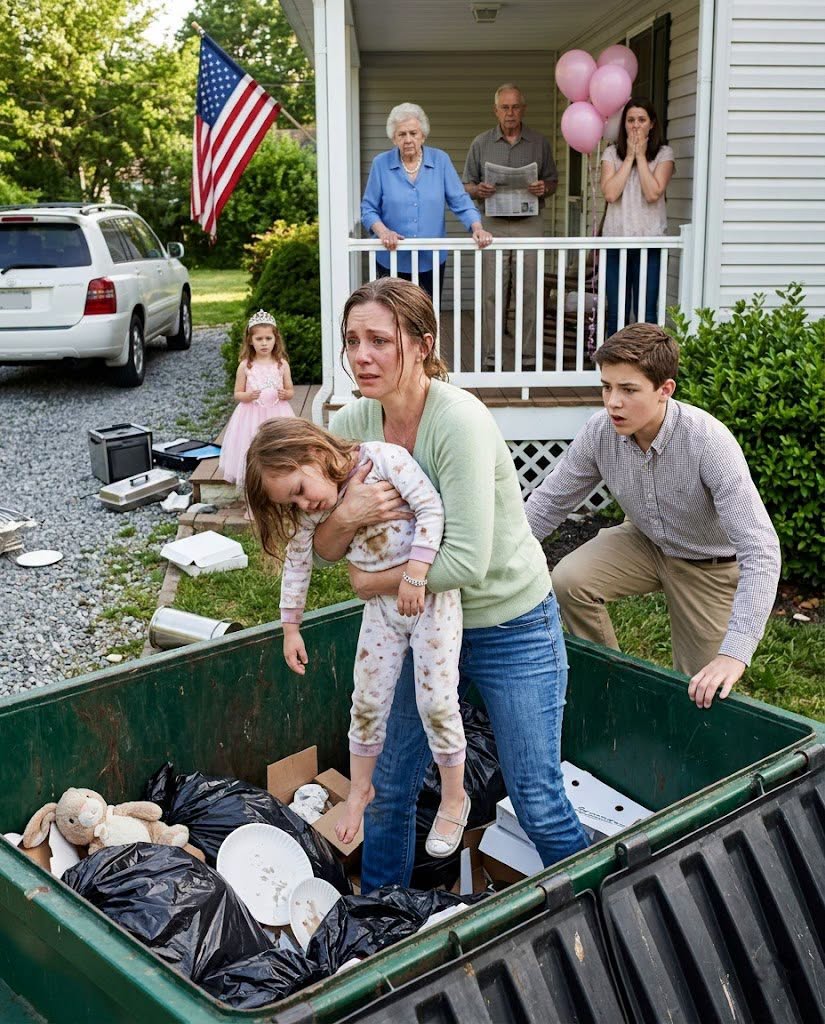
Sometimes they wait for a child’s fourth birthday.
Then they climb out of the trash with a pulse.
Related Stories