Chapter 6 - The House With the Yellow DoorOne year after the 911 call, Emily painted a door yellow.
It was not a real door.
Not at first.
It was a drawing in art therapy, made with thick paper, washable paint, and a brush she held too tightly until her therapist reminded her she was allowed to make mistakes.
Emily had painted houses before.
Houses with no doors.
Houses with tiny windows.
Houses with people standing outside unable to get in.
But this house had a door.
A bright yellow one.
And beside it, in careful purple letters, Emily wrote:
HELP CAN COME IN.
Katherine framed it.
She hung it in the hallway of their new apartment, right between a photo of Lydia holding baby Emily and a picture from Emily’s first day back at school.
Katherine had moved them across town after the trial.
Not far enough to erase Springfield.
Far enough to breathe.
The apartment was small, with creaky floors and a kitchen window that faced a maple tree. Emily chose the curtains herself. Yellow. Of course.
On Saturdays, they made pancakes. Sometimes strawberry. Sometimes chocolate chip. Sometimes both, because Katherine had decided survival deserved extra syrup.
Emily still had hard nights.
Healing did not arrive like a parade.
It came in pieces.
A full night of sleep.
A laugh that surprised her.
A door closing without panic.
A man speaking loudly in a grocery store and Emily not shrinking behind Katherine’s coat.
Some days she was angry.
Some days she missed her mother so badly she crawled into bed with Bunny and refused breakfast.
Some days she asked questions that broke Katherine’s heart.
“Did Mommy know I was scared?”
“Did Daddy ever love me?”
“Why did people believe him?”
Katherine answered carefully.
Honestly.
Lovingly.
“I think Mommy knew something was wrong, and she tried very hard to protect you.”
“Your father’s choices were not love.”
“Sometimes adults see what they want to see. But that does not make what happened your fault.”
Emily would listen.
Sometimes she believed it.
Sometimes she did not.
So Katherine said it again the next day.
And the next.
And the next.
At sentencing, Thomas Miller stood before Judge Price and finally spoke.
His lawyer had prepared a statement about regret, confusion, pressure, grief, and misunderstandings. Thomas read the first two lines, then abandoned the page.
He looked toward the gallery where Katherine sat.
Emily was not there.
Katherine would not let him have one more memory of her face.
Thomas said, “This has destroyed my life.”
That was his apology.
Not I hurt my daughter.
Not I lied.
Not I stole years from a child and tried to bury her mother’s truth.
Only this has destroyed my life.
Judge Price watched him for a long moment.
Then she said, “Mr. Miller, the most revealing part of your statement is that you remain the only victim in it.”
The courtroom went still.
She sentenced him to decades in prison.
She also referred Lydia Miller’s death investigation for further review after new evidence raised serious questions about the original accident findings.
Lorraine Miller left the courtroom without looking at Katherine.
But outside, on the courthouse steps, one of Thomas’s former defenders approached Katherine with tears in her eyes.
It was Mrs. Allen, the neighbor whose porch Thomas had fixed.
“I said he was a good man,” she whispered. “I said it online. I’m so sorry.”
Katherine was tired.
Too tired for cruelty.
Too tired for comfort.
So she told the truth.
“Don’t apologize to me. Next time, believe the child first.”
Mrs. Allen nodded, crying harder.
That line traveled farther than anyone expected.
A reporter wrote it down.
A local station aired it.
Within days, posters appeared in schools, clinics, churches, libraries, and community centers.
Believe the child first.
Claire Johnson kept one taped beside her dispatch console.
Daniel saw one at the police station.
María saw one at Emily’s school when she visited for career day.
She had not planned to see Emily that day. The visit had been arranged for the fourth-grade classes, and Emily was only in third. But as María stood beside a patrol car in the school parking lot, explaining radios and seat belts and how officers helped people, she saw a small face watching from behind a classroom window.
Emily.
For a moment, neither moved.
Then Emily lifted one hand.
Not a wave.
A tiny salute.
María returned it.
Later, Emily’s teacher found a note on María’s patrol car.
It was folded twice and written in purple pencil.
Dear Officer Lopez,
I am not scared of police anymore.
Thank you for coming inside.
From Emily.
María sat in the car for five minutes before she could drive.
Daniel framed his own note months later.
It arrived at the station in a yellow envelope.
Dear Officer Harris,
Thank you for opening the door.
Bunny says thank you too.
From Emily.
Daniel stared at the words until they blurred.
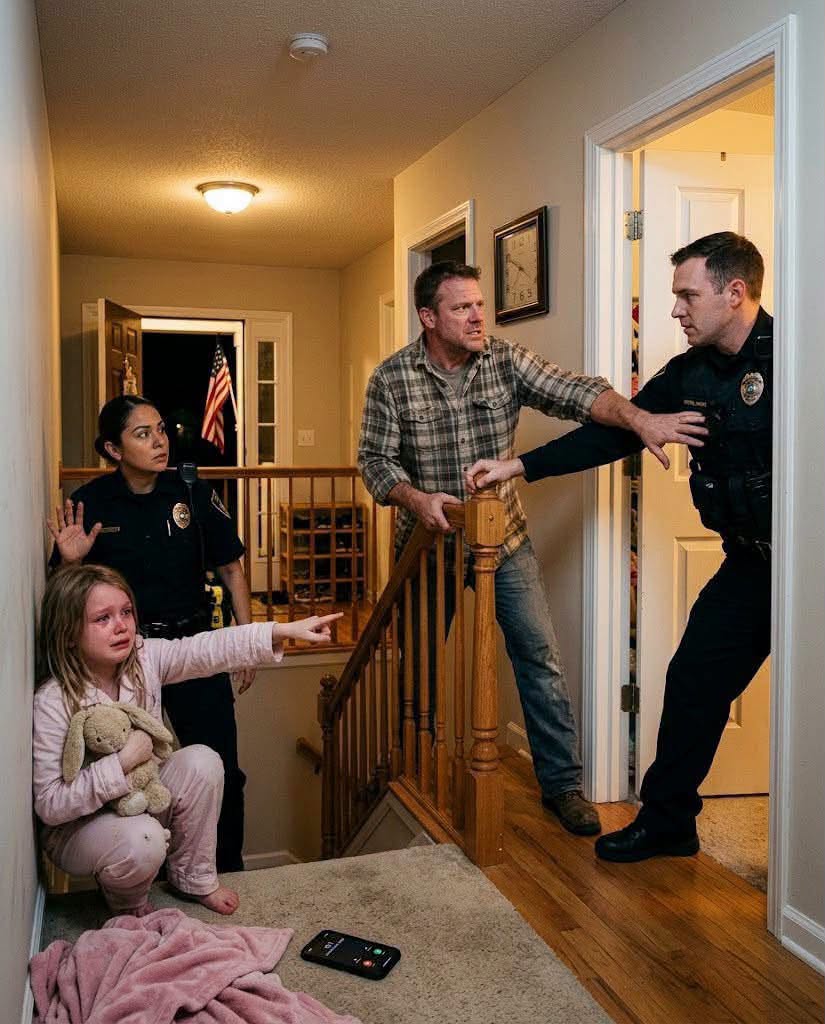
He had kicked down doors before.
Drug houses.
Domestic calls.
Robberies.
But that door on Maplewood Drive stayed with him differently.
Because the true barrier had not been wood.
It had been disbelief.
It had been manners.
It had been a smiling man saying, “She’s asleep.”
It had been every adult instinct that hesitated outside a clean house because the lawn was trimmed and the father sounded reasonable.
Daniel kept Emily’s letter in his locker beside the drawing.
Whenever a new officer asked why, he told them:
“Because kids don’t always have the words. Sometimes we have to hear what they mean.”
On the anniversary of the call, Claire Johnson received permission to meet Emily.
It happened in a quiet room at the advocacy center.
No uniforms.
No cameras.
No reporters.
Claire brought a small stuffed dog wearing a headset, because she had panicked in the gift shop and bought the first thing that made sense.
Emily arrived holding Bunny.
She stood near Katherine’s leg at first.
Claire crouched so they were eye level.
“Hi, Emily. I’m Claire.”
Emily studied her.
“Were you the phone lady?”
Claire smiled through tears.
“Yes.”
“You sounded nice.”
“I was trying really hard.”
Emily looked at the stuffed dog.
“Is that for me?”
“If you want him.”
Emily took it.
“What’s his name?”
“I thought you could pick.”
Emily considered this seriously.
Then she said, “Sir Waffles.”
Claire laughed.
So did Katherine.
So did Emily.
It was the first time Claire had heard her laugh.
Not on a recording.
Not through fear.
In real life.
The sound was small, but it filled the room.
That evening, Katherine drove Emily home under a sky turning pink at the edges. Emily sat in the back seat with Bunny on one side and Sir Waffles on the other.
“Can we paint my real door yellow?” Emily asked.
Katherine looked at her in the rearview mirror.
“To your bedroom?”
Emily nodded.
Katherine smiled.
“Yes. We can paint it yellow.”
So they did.
That Saturday, they covered the floor with old newspapers, wore messy T-shirts, and painted Emily’s bedroom door the color of morning light.
Emily got paint on her cheek.
Katherine got paint in her hair.
Bunny watched from a chair, retired from being brave but still deeply respected.
When they finished, Emily stood back and looked at the door for a long time.
Then she pressed her palm against it.
Not to keep it shut.
Not to hold danger out.
Just to feel that it belonged to her.
That night, for the first time since anyone could remember, Emily slept with the door halfway open.
No chair against it.
No fear of footsteps.
No secret waiting in the dark.
In the hallway, Katherine paused before going to bed and looked at the yellow door.
Behind it was not a broken child.
Not a headline.
Not evidence.
Not a victim in a case file.
Behind it was Emily.
A little girl who liked pancakes, purple crayons, and naming stuffed animals ridiculous things.
A little girl whose mother had loved her bigger than the moon.
A little girl who had called 911 when the monster had a human face.
And because someone answered, because officers came, because one tiny recorder inside one ragged rabbit refused to let the truth die, Emily Miller got something Thomas had tried to steal forever.
A childhood with doors that opened.
May you like

A home where secrets could not hurt her.
And a future painted yellow.