Chapter 9 - The Morning the Kingsleys FellCourthouses do not look dramatic enough for the things that happen inside them.
That was my first thought when Nora and I walked up the steps the next morning.
No thunder.
No orchestra.
No slow-motion crowd parting as truth arrived in a black coat.
Just stone columns, metal detectors, tired lawyers, nervous families, and people carrying paper cups of coffee like caffeine might hold their lives together.
But by 9:03 a.m., the Kingsley name was already circulating in whispers.
My mother had made sure of that.
She arrived in cream wool, pearls, and heartbreak.
My father arrived beside her, gray-faced but upright.
Grant arrived separately with a public defender and eyes fixed on the floor.
Paige came with Dana Holt and a victim advocate.
Victor Sloane did not come at first.
Men like him preferred rooms where they controlled the exits.
The emergency hearing was supposed to be limited.
That was what Nora told me.
A judge would review whether my trust needed protection, whether my parents had grounds to challenge it, whether the property trust provisions could be enforced, and whether evidence needed to be preserved.
But rich families never understand the difference between private pain and public record until it is too late.
My mother proved that before we even entered the courtroom.
She approached me in the hallway with two society women standing close enough to witness her performance.
“Evelyn,” she said softly.
I looked at Nora.
Nora gave the smallest nod.
Do not engage emotionally.
My mother reached for my hand.
I stepped back.
Her eyes filled instantly.
Perfectly.
“Oh, sweetheart,” she whispered. “Look what that woman has done to you.”
She meant Nora.
The two women behind her murmured.
My mother lowered her voice, but not enough. “You’re confused. We know that. We forgive you. Come home before this becomes something you can’t undo.”
I met her eyes.
For eighteen years, I had been afraid of disappointing her.
That morning, standing in a courthouse hallway, I realized she had never feared disappointing me.
Not once.
“Mom,” I said, “you tried to declare me incompetent because I wouldn’t give Dad money.”
Her tears stopped.
The women behind her went silent.
My father stepped forward. “Enough.”
“No,” I said. “That’s what you told me yesterday. Enough. Be quiet. Go upstairs. Smile. Leave by noon.”
My voice shook.
I let it.
“You don’t get to say enough anymore.”
Nora touched my elbow gently.
The courtroom doors opened.
Inside, Judge Maribel Santos presided with the expression of a woman who had no patience for expensive nonsense.
That was my first sign of hope.
Nora presented the trust documents first.
Clear.
Executed properly.
Signed after midnight? No. Signed two hours before the party, once I was legally able under the planned timing and estate terms. Proper witnesses. Independent counsel. Medical clarity not required, but no evidence of impairment. Funding instructions complete.
My parents’ attorney, a nervous man named Philip Aster, argued undue influence.
Judge Santos looked over her glasses.
“By whom?”
“Ms. Whitman,” he said.
“On what evidence?”
He glanced at my mother.
My mother lowered her eyes.
“Evelyn had been emotionally vulnerable,” he said.
Judge Santos turned a page. “Most people are emotionally vulnerable when managing family estates. That is not incapacity.”
My mother’s face tightened.
Then Nora played the voicemail.
You are still my daughter. Don’t make me defend this family from you.
My mother stared straight ahead, lips pressed together.
Then Nora played the Noon video.
The courtroom changed.
Not loudly.
No one gasped like in movies.
But the air shifted.
When my father’s voice said, We cancel her phone first, Judge Santos stopped taking notes.
When my mother said, I would do anything to save this family, Paige closed her eyes.
When my father said, Comfort costs obedience, something inside me finally detached.
Those words belonged to him now.
Not to me.
Nora moved next to the forged authorization.
Handwriting concerns.
Metadata.
Grant’s copied file.
Text messages.
Grant’s attorney stood and stated his client was prepared to cooperate regarding the origin of the document.
My father turned so fast I thought he might fall.
“Grant,” he hissed.
Judge Santos struck the bench lightly. “Mr. Kingsley, you will not address witnesses in my courtroom.”
Witnesses.
My brother was no longer the golden son.
He was a witness against them.
Then came the property trust.
My mother went pale.
Nora explained that the mansion was held in a Hale family trust with conditional occupancy rights. She submitted evidence that protected estate property had been misused, including the bracelet, and that discussions had occurred about challenging or leveraging the property trust for debt.
Judge Santos read in silence.
The silence lasted so long my heartbeat became painful.
Finally, she looked up.
“Mr. and Mrs. Kingsley, did you instruct your daughter to leave the residence yesterday?”
My father’s attorney stood. “Your Honor, that matter is being mischaracterized.”
The judge looked at him.
He sat down.
My father cleared his throat. “We asked Evelyn to take space.”
“No,” I said before I could stop myself.
Everyone turned.
Judge Santos studied me. “Miss Kingsley, you’ll have a chance to speak.”
I nodded, embarrassed.
But the judge did not look angry.
My mother whispered, “We were hurt.”
Judge Santos looked back down at the file. “Hurt does not create legal authority.”
By 11:40 a.m., the order came.
The Hale Education and Independence Trust remained valid and protected.
My parents were barred from contacting me directly except through counsel.
All documents related to my inheritance, the loan agreements, the forged authorization, the hotel records, and Hale property assets had to be preserved.
The family could not challenge the property trust without court review.
And then Judge Santos delivered the sentence that made my mother grab the table.
“Given the evidence presented, the court finds sufficient basis to suspend Charles and Cynthia Kingsley’s occupancy privileges pending full review of the Hale property trust.”
My mother stood. “You can’t take my home.”
Judge Santos looked at her calmly.
“Mrs. Kingsley, based on the documents before me, it is not your home.”
The courtroom froze.
There it was.
The truth, stripped of chandeliers and charity smiles.
My mother slowly sat down.
My father looked like he had aged ten years in ten minutes.
Grant covered his face.
I did not feel happy.
I had expected revenge to taste sweet.
It didn’t.
It tasted like ash and relief.
Outside the courtroom, reporters were waiting.
Not hundreds. Not yet.
But enough.
My mother tried to walk past them with dignity.
A reporter called, “Mrs. Kingsley, did you try to access your daughter’s inheritance?”
Another asked, “Is it true you were removed from the mansion trust?”
My father kept walking.
Grant stopped.
His attorney grabbed his sleeve, but Grant looked at the cameras and said one sentence.
“My sister protected herself because she had to.”
Then he walked away.
By noon, the same gossip account that had called me spoiled posted a new headline.
COURT RECORDS SUGGEST KINGSLEY FAMILY ATTEMPTED TO PRESSURE 18-YEAR-OLD HEIRESS OVER $3 MILLION TRUST.
By one, the charity board deleted the post about my mother’s heartbreak.
By two, family friends who had commented cruel things were sending private messages.
I’m so sorry.
We didn’t know.
Hope you’re okay.
You’re so strong.
I deleted most of them.
At three, Nora took me to the mansion.
Police were already there to supervise access.
My parents had forty-eight hours to remove personal belongings under court conditions.
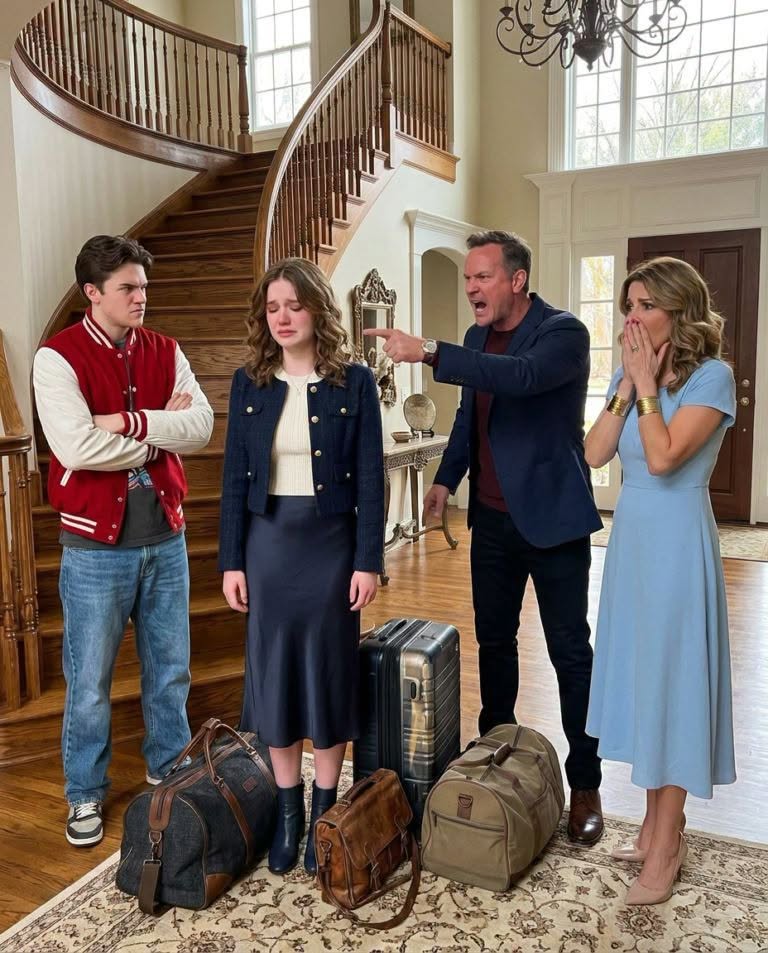
My mother stood in the foyer when I entered.
The same foyer where she had watched me leave with two suitcases.
Her cream coat was gone. Her pearls were gone. Her face was bare in a way I had never seen before.
For one second, I saw not a villain, but a woman whose entire life had been built on being envied.
And now there was nothing left to envy.
She looked at me.
“You must be very proud,” she said.
I shook my head.
“No, Mom.”
Her mouth trembled, but whether from sadness or rage, I could not tell.
“I’m free.”
That hurt her more.
Behind her, workers began covering the paintings and inventorying furniture.
The house echoed with footsteps.
A kingdom being counted.
A lie being packed.
May you like

And as I walked up the staircase to my old room, I realized something strange.
The mansion had never felt smaller.