Chapter 9 - The Farm They Couldn’t StealThe arrests came like thunder rolling across open land.
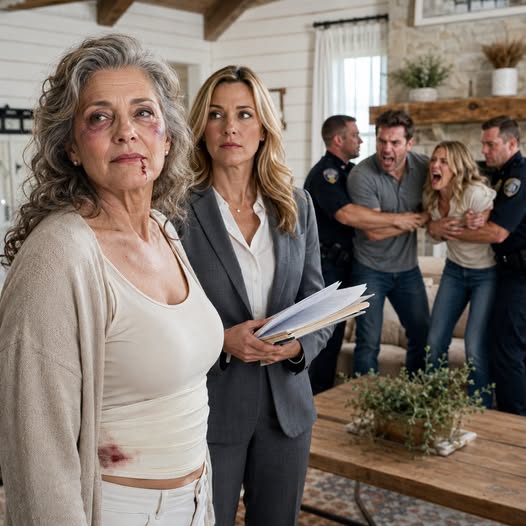
Warren Pike first.
Then Dr. Harlan, who had signed questionable cognitive evaluations for three elderly landowners he had barely examined.
Then Caleb Bell, Margaret’s grandson.
Then two North Ridge consultants whose names had appeared in too many contracts to be coincidence.
Each arrest cracked the story wider.
By the end of the week, state investigators had frozen assets tied to several land purchases. Families who thought they had gotten away with betrayal suddenly discovered that paper trails do not stay buried when enough angry women start digging.
Melissa tried one final performance.
She gave an interview outside her attorney’s office, wearing dark sunglasses and a pale pink blazer.
“My husband and I only wanted what was best for Evelyn,” she said tearfully. “This has been twisted by people who hate successful families.”
The reporter asked, “Why did you text a private investigator to scare her?”
Melissa ended the interview.
The clip went viral in exactly the way she did not intend.
Lily sent it to me with the message: She really thought sunglasses were a legal defense.
I laughed so hard my ribs punished me.
Healing was slow.
Not just the bones.
The house had to heal too.
Tom repaired the office door. Rebecca polished the kitchen floor where Melissa’s muddy footprints had been. Lily tied fresh blue ribbons along the fence every few days when old ones frayed.
And I finally let someone fix the table.
A carpenter named Henry Ward came by after church with his toolbox. He had gone to school with Daniel and said very little about it, which I appreciated.
He examined the broken leg, ran a hand over the dented edge, and said, “This table’s got another fifty years in it.”
“So do I,” I replied.
He smiled.
“Then we better make it sturdy.”
While Henry worked, I sorted Samuel’s papers with Claire.
The records revealed more than we expected.
Daniel had taken small amounts over years. Equipment refunds deposited into his account. A forged reimbursement request. A loan Samuel had quietly paid off to keep Daniel from prosecution when Lily was still little.
At first, anger burned through me.
Then came grief.
Samuel had carried that alone.
He had protected our son from consequences, hoping mercy would become a lesson.
It had become permission.
“I wish he had told me,” I said.
Claire sat across from me at the repaired table.
“Maybe he thought he was sparing you.”
“He was wrong.”
“Yes,” she said gently. “Love is often wrong when it tries to protect people from truth.”
That sentence stayed with me.
The next day, I asked Rebecca and Lily to come over.
We sat on the porch with lemonade while cattle grazed beyond the fence.
Lily looked nervous.
“Grandma, is Dad going to prison?”
“I don’t know,” I said.
“Do you want him to?”
The question pierced me.
I looked across the fields.
Did I want my son in prison?
No mother wants that in the simple way people imagine revenge. I did not wake each morning hungry for his suffering. I did not enjoy picturing him behind bars.
But I wanted the truth to matter.
I wanted my ribs to matter.
I wanted every widow who had been called confused by greedy relatives to matter.
“I want him held responsible,” I said. “What that looks like is up to the court.”
Lily nodded slowly.
“Mom says that’s different from hate.”
Rebecca touched her shoulder.
“It is.”
I looked at my former daughter-in-law. For years, I had kept polite distance after the divorce, afraid loyalty to Daniel required distance from her.
Another mistake.
“I owe you an apology,” I said.
Rebecca blinked. “Me?”
“When you left Daniel, I told myself marriage was complicated. I did not ask enough questions.”
Her eyes filled.
“Evelyn, you had just lost Samuel.”
“That explains it. It doesn’t excuse it.”
Rebecca looked away toward the barn.
“He never hit me,” she said quietly. “But he made every room feel like it belonged to his anger.”
Lily leaned into her mother.
I reached for both their hands.
“Then we make new rooms.”
That summer, Hartwell Farm changed.
Not the land.
The land remained blessedly stubborn.
But people came.
Women brought folders. Men brought old deeds. Adult children came with parents they had suddenly started listening to. Claire held free legal clinics in the barn every Saturday morning. Agent Cross sent resources. The state agricultural office offered help setting up protections for vulnerable landowners.
Margaret Bell came once, wrapped in a quilt, and cried when she saw the creek.
“It smells like home,” she said.
That day, I made a decision.
Hartwell would become more than a farm.
The conservation trust protected the land. My retirement plan protected me. But Samuel and I had always believed land should feed more than bank accounts.
So Claire helped me create the Samuel Hart Rural Legacy Fund.
Its purpose was simple: provide legal assistance to aging farmers and widows facing coercion, fraud, or family pressure over land.
When the announcement ran in the paper, Daniel requested another meeting.
I almost said no.
Then I went.
This time, I did not go to the jail as a wounded mother seeking answers.
I went as Evelyn Hart.
Landowner.
Widow.
Survivor.
Daniel entered slowly.
His face had changed again. Less rage. More ruin.
He sat behind the glass.
I picked up the phone.
He did not call me Mom.
He said, “Mrs. Hart.”
That hurt in a way I was not prepared for.
Then he began to cry.
Not the frightened tears from before.
These were quieter.
“I pleaded guilty to the assault,” he said. “And to the attempted fraud.”
I said nothing.
“I’m cooperating on the land scheme.”
Claire had told me that might happen.
It would likely reduce his sentence.
It would also help other families.
Both things could be true.
Daniel wiped his face.
“I don’t expect you to forgive me.”
“Good,” I said. “Because forgiveness is not a coin you can demand because you finally told the truth.”
He nodded.
“I know.”
For a long time, we simply looked at each other.
Then he said, “Did Dad hate me?”
The question broke something open.
“No,” I said.
Daniel closed his eyes.
“He saw me, didn’t he?”
“Yes.”
His shoulders shook.
“I wish he hadn’t.”
“I wish you had become someone easier to see.”
He pressed his hand to the glass.
This time, I did not touch my hand to the other side.
“I am sorry,” he whispered.
I believed him.
Not enough to erase anything.
But enough to mourn properly.
“I hope you become someone who understands what those words cost,” I said.
Then I hung up.
As I walked out, the sun struck my face.
For the first time since the assault, I did not feel like Daniel’s mother first.
May you like

I felt like myself.
And Hartwell Farm was waiting.