Chapter 8 - THE WOMAN THEY PUT ON TRIAL
The trial began eight months after my father’s birthday party.
By then, Ava’s stitches had healed.
The fracture had closed.
Her hair had grown long enough to hide the thin scar near the back of her head.
But she still became frightened when a man raised his voice.
She refused to enter kitchens with tile floors.
And whenever someone removed a belt, even casually, her entire body stiffened.
Healing was not the same as forgetting.
Harold Bennett faced charges in two consolidated cases.
The first involved Ava.
The second involved Andrew Price’s death, evidence concealment, intimidation, and conspiracy.
Uncle Thomas accepted a plea agreement and agreed to testify in exchange for avoiding a possible life-without-parole sentence.
Caleb pleaded guilty to kidnapping Lauren, assault, and evidence tampering. His sentencing was postponed until after my father’s trial because prosecutors wanted his cooperation.
My mother also entered a cooperation agreement.
None of them walked away innocent.
That mattered to me.
Truth without accountability would have been another family lie.
The prosecution presented the birthday videos first.
Seven angles.
Seven pieces of the same nightmare.
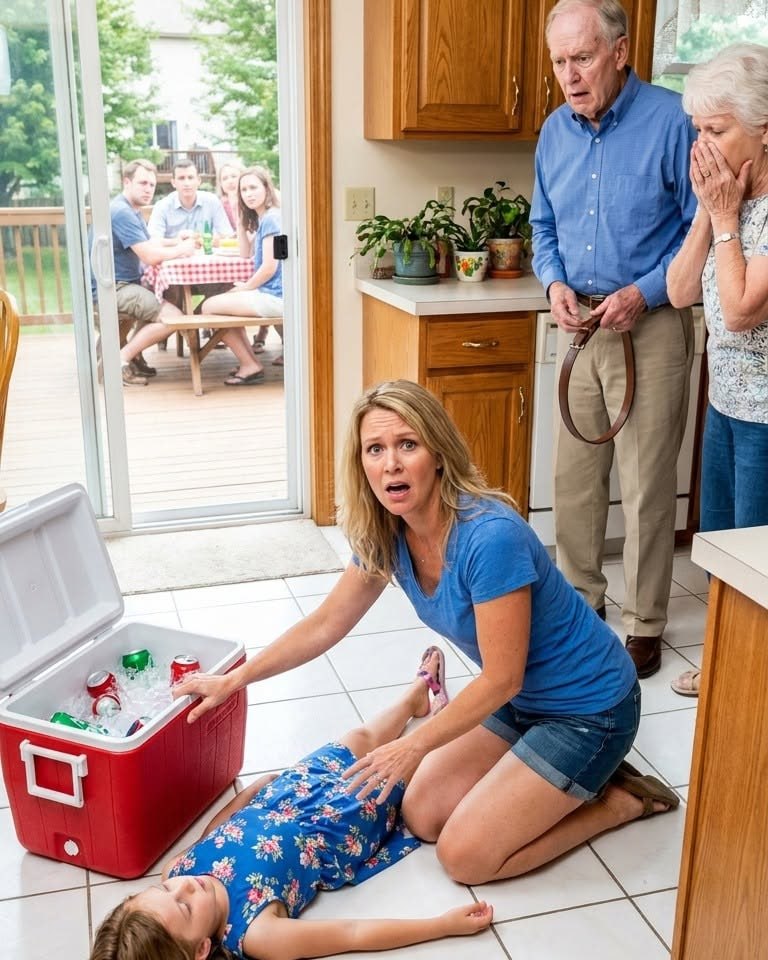
On the largest courtroom screen, my father removed his belt.
Ava stepped backward.
The buckle flashed under the kitchen light.
She slipped.
Her head struck the tile.
People gasped even though most had seen the footage in the news.
My father looked away.
The video continued.
It captured Lauren saying someone needed to teach Ava respect.
Then my mother’s voice:
“She deserved it.”
Finally, it showed my father standing over his unconscious granddaughter without kneeling, calling for help, or showing concern.
The jurors watched him carefully.
Dr. Patel testified about the skull fracture and the potential for fatal complications.
A child-development specialist explained that a three-year-old would reasonably perceive an adult swinging a belt as an immediate physical threat.
Denise Carter took the stand next.
She described what happened to Matthew.
The photographs were admitted over the defense’s objection.
Victor Lang attacked her for accepting money.
“You took ten thousand dollars and left,” he said.
“I was threatened.”
“But you accepted the money.”
“Yes.”
“You never returned it.”
“No.”
“You never contacted authorities again.”
“No.”
“So for twenty-seven years, you remained silent.”
Denise looked toward my father.
“So did everyone who had more power than I did.”
Lang’s expression tightened.
Lauren testified for nearly four hours.
She described the punishment involving dried rice.
The prom-night beating.
The years of fear after I left for college.
Then she described the party.
“Why did you say Ava needed to learn respect?” Dana asked.
Lauren took a long breath.
“Because I had been trained to protect my father before I protected an injured child.”
“What changed?”
“I saw Claire holding Ava. And I realized we had become the adults who once failed us.”
Victor Lang was ruthless on cross-examination.
“You lied to police at the party.”
“Yes.”
“You concealed evidence for years.”
“Yes.”
“You removed property from your mother’s home.”
“Yes.”
“You were kidnapped by your brother after accusing your father.”
“I did not accuse my father until after Caleb restrained me.”
“You suffer from anxiety.”
“Yes.”
“You take medication.”
“Yes.”
“You have attended therapy.”
“Yes.”
“Would it be fair to say your memory can be affected by emotional stress?”
Lauren looked at him.
“Stress affects everyone’s memory. That is why photographs, recordings, medical reports, and videos are useful.”
Several jurors smiled.
Lang did not.
My mother testified next.
Her testimony was devastating because she admitted everything.
The payments.
The false stories.
The hidden records.
The cleaning of Andrew’s blood.
The concrete slab.
Dana did not portray her as a hero.
Neither did my mother.
“I told myself I was protecting my children,” she said. “But I was protecting my fear. Every time I covered for Harold, I taught my children that his violence mattered more than their pain.”
My father stared at her with open hatred.
When Uncle Thomas testified, he confirmed that Andrew was alive when they moved him from the dock.
“What happened at the guesthouse?” Dana asked.
Thomas’s voice broke.
“Harold said we couldn’t take him to a hospital.”
“Did Andrew speak?”
“He asked for his mother.”
A woman in the gallery sobbed.
Andrew’s mother, now in her eighties, sat between her two surviving children.
“What did the defendant do?” Dana asked.
“He covered Andrew’s mouth because he was making noise.”
“For how long?”
Thomas began crying.
“Too long.”
The medical examiner testified that Andrew likely died from suffocation combined with complications from the head injury.
Then Daniel Ruiz entered the courtroom.
He walked slowly with a cane.
He identified my father without hesitation.
“That’s the man who threatened my children,” he said.
The defense suggested Ruiz had created a false identity to avoid prosecution for financial crimes.
The prosecution produced federal records showing he had repeatedly attempted to report the Bennett scheme before disappearing.
Finally, it was my turn.
I swore to tell the truth and sat facing the jury.
Dana began with the party.
Then she moved backward.
The basement.
The belt.
The rehearsed lies.
The years of therapy.
I explained why I had left home and why I had nearly skipped the birthday celebration.
“Why did you attend?” Dana asked.
“Because my mother promised nothing would happen.”
“Did you believe her?”
“I wanted to.”
“And when Ava asked to leave?”
“I told her we would leave after the cake.”
My voice weakened.
“I will regret that for the rest of my life.”
Dana paused.
“Who is responsible for Ava’s injury?”
“My father.”
“Are you responsible because you attended the party?”
“No.”
“Is Ava responsible because she picked up a soda?”
“No.”
“Is your husband responsible because he could not cross the yard quickly enough?”
“No.”
“Then why do you regret staying?”
“Because survivors often confuse hindsight with control. We believe that if we blame ourselves enough, we can pretend the danger was predictable.”
The courtroom was silent.
On cross-examination, Lang placed my entire life beneath a microscope.
He asked about panic attacks.
Nightmares.
Medication.
Estrangement.
Arguments with my parents.
He quoted selected sentences from therapy notes that the judge had permitted after extensive review.
“You once told your therapist you wanted your father to experience public humiliation.”
“Yes.”
“So you wanted revenge.”
“I wanted accountability. At the time, I didn’t understand the difference.”
“You resented him for controlling your childhood.”
“Yes.”
“You blamed your mother.”
“Yes.”
“You have built a career around prosecuting and defending violent people.”
“I work in criminal law.”
“You understand how to shape testimony.”
“I understand the importance of evidence.”
“You told guests to preserve recordings.”
“Yes.”
“You instructed police to separate witnesses.”
“I suggested standard investigative precautions.”
“You behaved like an attorney, not a frightened mother.”
I looked directly at him.
“I was both.”
Lang walked closer.
“Isn’t it true that your father never touched Ava?”
“He did not need to make contact for his actions to cause her injury.”
“The belt struck no one.”
“He used it to create terror.”
“You cannot know what he intended.”
“No. But I know what he taught us the belt meant.”
Lang turned toward the jury.
“Your memories of childhood are emotional, fragmented, and influenced by years of therapy. Correct?”
“Some memories are fragmented.”
“So you could be mistaken.”
“About certain details, yes.”
He smiled.
“Then how can this jury trust you?”
I looked toward the screen where the frozen image showed my father holding the belt above Ava.
“They do not have to trust every childhood memory I possess.”
I pointed toward the image.
“They can trust the video.”
Lang’s smile disappeared.
The defense called my father as its final witness.
Against his attorney’s likely advice, Harold chose to testify.
He blamed my mother.
Caleb.
Thomas.
The media.
Me.
He called the birthday incident a misunderstanding.
He claimed Andrew’s death was an accident.
He said every act of discipline in our childhood had been exaggerated.
Dana approached for cross-examination carrying the brown leather belt inside an evidence bag.
“Mr. Bennett, do you recognize this?”
“Yes.”
“What did this belt represent in your home?”
“A belt.”
“Nothing more?”
“No.”
Dana played the basement recording.
My father’s younger voice filled the courtroom.
Tell them you fell from the tree.
Dana stopped the audio.
“Was that discipline?”
“My son was injured. Everyone was upset.”
She played another section.
If Caleb tells anyone, I’ll send him somewhere you’ll never find him.
“Was that protection?”
“I was angry.”
She played the birthday video.
Ava fell.
My father stood motionless.
Dana paused the image.
“Your granddaughter was unconscious. Why didn’t you help her?”
“I was in shock.”
“Yet you ordered guests to stop recording.”
“I value privacy.”
“You threatened Claire from jail.”
“I wanted to resolve a family matter.”
“You broke into her home.”
“I wanted to speak with her.”
“You stole Andrew’s watch.”
“I believed it belonged to my son.”
Dana placed a photograph of the engraving before him.
A.P.
“Your son’s name is Caleb.”
My father said nothing.
Dana stepped closer.
“For thirty-five years, every injured child around you was blamed, silenced, paid off, or buried.”
“Objection!”
“Sustained.”
Dana rephrased.
“Is there any harm discussed in this courtroom for which you accept personal responsibility?”
My father looked at the jury.
Then at me.
Then at Ava’s empty seat in the family section.
She had not been allowed to attend.
His jaw tightened.
“No,” he said.
That single word became the most honest thing he said during the entire trial.
The jury began deliberations on a Friday afternoon.
Five hours later, the court clerk announced they had reached a verdict.
We returned to the courtroom.
My father stood.
The foreperson unfolded the paper.
On the first count, aggravated child abuse involving Ava, the verdict was guilty.
On the murder count involving Andrew Price, guilty.
Conspiracy, guilty.
Evidence tampering, guilty.
Witness intimidation, guilty.
Burglary, guilty.
One conviction followed another.
My father’s shoulders dropped slightly with each word.
When the clerk finished, Andrew’s mother cried into her daughter’s shoulder.
Lauren held my hand.
My mother, waiting for sentencing in a separate case, was not present.
My father turned toward me as deputies approached.
For the first time in my life, he looked afraid.
“You did this,” he said.
I shook my head.
“No.”
I looked at the evidence table.
At the belt.
At Andrew’s watch.
May you like

At decades of records he believed no one would ever see.
“You did.”