Chapter 12 - I Didn’t Lose a Husband—I Found MyselfSix months later, I bought a small blue house with white shutters and a maple tree in the front yard.
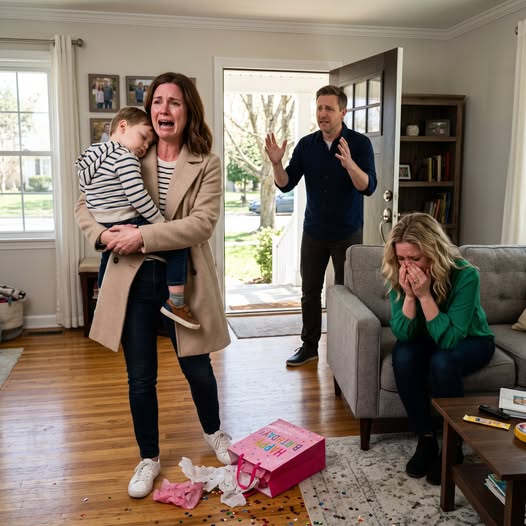
It was not as large as the house Mark and I had shared.
The kitchen cabinets were older. The upstairs hallway creaked. The backyard fence needed painting, and the guest bathroom had wallpaper with tiny yellow flowers that Noah insisted looked like “happy popcorn.”
But the first night we slept there, Noah did not ask if Daddy was mad.
He did not ask if secrets were bad.
He ran from room to room in dinosaur pajamas, laughing because his voice echoed in the empty spaces.
“This house sounds funny!” he shouted.
I stood in the doorway holding a box of dishes and cried.
Not because I was sad.
Because peace had a sound.
And for the first time in years, I could hear it.
The divorce was not final yet, but the shape of my future had become visible. Mark had supervised visitation twice a week. At first, he fought it bitterly. He filed objections. He sent angry messages through the parenting app that Caroline calmly preserved. He accused me of turning Noah against him, even as every supervisor’s report said the same thing:
Child is affectionate but cautious.
Father redirects conversations toward adult conflict.
Father requires reminders not to question child about mother.
Mark did not like being observed.
People who rely on private manipulation rarely do.
Emily disappeared from social media for a while.
Then she came back with softer posts.
Healing isn’t linear.
Learning to forgive myself.
Choosing growth.
Rachel sent me screenshots with sarcastic captions until I finally told her to stop because Emily’s performance no longer mattered to my healing.
My parents stopped paying for Emily’s condo.
She moved into a smaller apartment forty minutes away and got a second job. Mom told me this carefully, as if testing whether I would feel sorry for her.
I did.
A little.
But pity was not an invitation back into my life.
That was a lesson I had earned the hard way.
My mother and I were rebuilding slowly.
Not with grand speeches.
With small, consistent choices.
She asked before coming over.
She did not mention forgiveness.
She attended one therapy session with me and cried when the therapist asked why she had always expected the stronger daughter to need less care.
“I thought Claire could handle anything,” Mom said.
The therapist asked, “Did anyone ever ask whether she should have to?”
My mother could not answer.
That answer mattered.
Dad became Noah’s favorite Saturday person. They built birdhouses, burned pancakes, and invented a game called Mud Inspector that involved rain boots and absolutely no rules I understood.
One Saturday, Dad found me on the porch watching Noah chase bubbles across the yard.
“You look lighter,” he said.
“I feel tired.”
“Lighter and tired can both be true.”
I smiled.
He sat beside me.
“I keep thinking about when you were little,” he said. “You used to carry Emily’s backpack when hers got too heavy.”
I looked at him.
His eyes stayed on Noah.
“We praised you for it,” he continued. “Called you helpful. Mature. Such a good big sister.” His voice thickened. “Maybe we taught you your job was carrying things that weren’t yours.”
The words settled into me.
Not as blame.
As recognition.
“I loved her,” I said.
“I know.”
“I think that’s what makes it so ugly.”
Dad nodded. “Love doesn’t always protect us from people. Sometimes it just keeps us standing close enough for them to hurt us.”
Across the yard, Noah shouted, “Mommy! Grandpa! Look!”
He blew one giant bubble that floated above the maple tree, shining in the sun for one perfect second before disappearing.
Noah clapped like magic had happened.
Maybe it had.
The final settlement meeting took place in August.
Mark looked thinner. Angrier. Less polished. His company had not fired him, but his reputation had changed. Apparently, when the financial disclosures expanded, his “business trips” became difficult to explain. David Lang never called me again, but Caroline later said Mark’s expense reports were under internal review.
Consequences have quiet ways of multiplying.
Emily did not attend, but her statement remained part of the record.
Mark agreed to a settlement after Caroline made it clear that trial would bring far more evidence into public view.
I received primary physical custody.
The house was sold.
Marital assets were divided after reimbursement for funds spent on the affair.
Mark’s visitation plan included a path toward unsupervised time only after parenting counseling and consistent supervisor reports.
He hated every line.
I signed anyway.
Outside the conference room, he caught up to me near the elevators.
For one second, I thought he might apologize.
A real apology this time.
No audience. No performance. No legal strategy.
Just truth.
Instead, he said, “Was it worth it?”
I turned.
He looked at me with exhausted resentment.
“All this,” he said. “Lawyers. Money. Noah confused. Your family broken. Was it worth proving a point?”
I studied the man I had married.
Once, I would have searched his face for the version of him I loved. The hospital room father. The man who danced with me barefoot in our first apartment. The husband who whispered promises into my hair.
But now I understood something.
Memories are not evidence of present character.
They are only proof that someone once knew how to look like love.
“I didn’t prove a point,” I said. “I protected my son.”
His jaw moved.
“And my family isn’t broken because I told the truth. It was broken when you and Emily decided lies were more convenient than loyalty.”
The elevator opened.
I stepped inside.
Mark did not follow.
As the doors closed, he said my name once.
“Claire.”
I looked at him.
For the first time, I felt nothing sharp.
No longing.
No rage.
No need for him to understand.
Just distance.
The doors shut.
That was the end of us.
The legal end came three weeks later.
The emotional end had happened much earlier, in the rain, when I locked the car doors and chose silence over spectacle.
On the day the divorce finalized, I picked Noah up from preschool and took him for cupcakes.
Not pink frosting.
Chocolate.
His favorite.
We sat outside the bakery at a tiny metal table while August heat shimmered over the sidewalk.
Noah got frosting on his nose.
“You’re smiling,” he said.
“I am.”
“Why?”
I thought about how to answer.
Because the papers were signed.
Because the lies were named.
Because the woman who once drove forty minutes carrying a gift bag had become someone who could carry herself.
“Because today is a new day,” I said.
He considered this carefully.
“Can new days have cupcakes?”
“Absolutely.”
He grinned.
That evening, we went home to the blue house.
I cooked spaghetti. Noah fed one noodle to his stuffed giraffe. We danced in the kitchen to a song he liked, spinning between unpacked boxes and mismatched chairs.
Later, after I tucked him in, he grabbed my hand.
“Mommy?”
“Yes, baby?”
“Are we safe here?”
My throat tightened, but I smiled.
“Yes,” I said. “We are safe here.”
He nodded, satisfied, and closed his eyes.
Downstairs, I made tea and sat by the front window.
The maple tree moved gently in the dark.
For months, people had asked what I lost.
A husband.
A sister.
A version of my family.
A house.
A life I thought was mine.
But loss was not the whole story.
I had gained quiet mornings without suspicion.
A son who was learning that love should not require secrets.
Parents who were finally learning that peace without truth is only silence.
A home where nobody had to perform.
And myself.
The self I had abandoned in tiny pieces every time I explained away Mark’s absence, every time I comforted Emily’s jealousy, every time I accepted being called strong instead of being cared for.
The night I found them, I thought I was walking away from everything.
But I was wrong.
I was walking back to the only things still worth saving.
My son.
My dignity.
May you like

My life.
And this time, I had the keys.