Chapter 6 - THE SIGNATURE THAT WASN’T MINEDiego’s divorce petition was designed to frighten me.
It did the opposite.
Fear is strongest when danger is unclear.
Now the danger had placed its strategy in writing.
Diego intended to portray me as violent, unstable, and financially abusive. He claimed that he had contributed to the purchase and renovation of my condominium, even though bank records showed I had bought it eighteen months before we met.
He also claimed that my career success existed only because Romero Development had provided contracts to my firm.
That part carried just enough truth to be dangerous.
Gabriel’s company had hired Halston & Pierce for several commercial projects after Diego and I married. Richard Halston had praised my “valuable family connections.”
At the time, I thought Diego was supporting my work.
Now I wondered whether he had been building a future argument that everything I achieved belonged to him.
Maya Brooks read the petition twice.
“They’re overreaching.”
“Will that matter?”
“Yes. Judges dislike dishonest litigants, especially when there are documents.”
“What about Richard’s statement?”
“We challenge it.”
Richard claimed he had witnessed me verbally abusing Diego during a company retreat.
The event had taken place in Vail.
I remembered the argument.
Diego had demanded that I leave a client dinner because he was bored. I refused. He followed me into the hotel lobby and called me selfish.
Richard saw the end of the exchange.
Now he described Diego as “calm” and me as “aggressive.”
“Why would Richard risk lying under oath?” Natalie asked.
I knew the answer.
“Aurora Heights.”
Halston & Pierce had received a design contract worth almost twelve million dollars. If the project stopped, the firm could lose a fortune.
If investigators discovered the company had ignored safety concerns, Richard could lose more than money.
He could lose his license.
Detective Mills obtained a search warrant for Diego’s storage unit that afternoon.
I was not allowed inside, but he later brought photographs.
Boxes filled the unit from floor to ceiling.
My office files.
Condominium association records.
Copies of residents’ signatures.
Building access logs.
A lockbox containing duplicate keys.
Property appraisals for six units in my building.
Capitol Residential Holdings had been preparing to seize control of the association through fraudulent purchases and coerced transfers.
Then Mills showed me a photograph of a portable scanner.
“They copied every document they removed from your office.”
“Did you find the Aurora folder?”
“No.”
“What about the flash drive?”
“No.”
The missing evidence remained dangerous.
Without my original photographs, the Romeros could argue that the safety discrepancies were only my opinion.
Fortunately, architects do not rely on a single copy.
At least, cautious architects do not.
I contacted a structural engineer named Dr. Evelyn Shaw.
She had reviewed my concerns privately six months earlier.
When I called, she was silent for a long time.
“I heard about your husband,” she finally said.
“I need the calculations you performed on Aurora Heights.”
“I was told those calculations were no longer relevant.”
“Who told you?”
“Richard Halston.”
“When?”
“Yesterday morning.”
Before the dinner.
Richard had begun containing the Aurora problem before Diego assaulted me.
“Did you delete them?”
“No.”
Relief nearly made me dizzy.
“I keep encrypted backups.”
“Evelyn, the specifications were changed after city approval.”
“I know.”
“Would the changes create a serious risk?”
Another silence.
“The substituted support connections may not meet the required load during high wind conditions.”
“How serious?”
“If the installation matches the revised drawings, upper-floor movement could exceed safe limits.”
Aurora Heights was already under construction.
Workers had completed twenty-six floors.
Luxury units were being sold for millions.
Families would eventually sleep inside that building.
“Will you speak to investigators?”
Evelyn sounded afraid.
Then she said, “Yes.”
That single word became another crack in the Romero family’s wall.
Maya contacted the state attorney general’s economic-crimes division. Detective Mills forwarded the ledger photographs and property documents.
The assault investigation began expanding into fraud, bribery, witness intimidation, and construction misconduct.
But before authorities could search the mansion, someone removed the blue ledger.
Police executed the warrant at six the next morning.
The hidden panel was empty.
Victoria claimed Natalie invented the book.
Gabriel called the photographs fabricated.
The family’s attorneys argued that Natalie had manipulated the images to punish her husband.
Fortunately, one detail betrayed them.
Natalie’s photograph showed the corner of a handwritten page beneath the ledger.
A payment amount and partial name were visible.
Investigators found the torn lower half of that exact page in Gabriel’s office shredder.
He had destroyed the ledger too quickly.
Not completely.
The recovered fragment mentioned Patrick Sloan and a payment of forty thousand dollars.
Patrick was arrested that afternoon.
Within three hours, he began cooperating.
He admitted that Victoria hired him to acquire units in my condominium building. She offered bonuses for each elderly or financially vulnerable owner he convinced to sell.
When owners refused, Romero Development gathered private information about their debts, divorces, health problems, and relatives.
They used pressure.
Threats.
Fake code violations.
One owner had received anonymous photographs of his teenage daughter walking to school.
Patrick insisted he had not known about the forged deed until Diego gave it to him.
Nobody believed that part.
But he provided something valuable.
An email from Diego containing the false transfer documents.
The subject line read:
FINAL SOLUTION FOR UNIT 1204.
My home reduced to a number.
My refusal reduced to a problem.
My forged signature reduced to a solution.
The notary stamp had been supplied by Victoria.
Gabriel’s assistant prepared the paperwork.
Diego practiced my signature using old birthday cards.
The dinner was supposed to produce a real signature.
Victoria planned to place a property-transfer agreement in front of me after dessert. Surrounded by relatives, I would be pressured into signing.
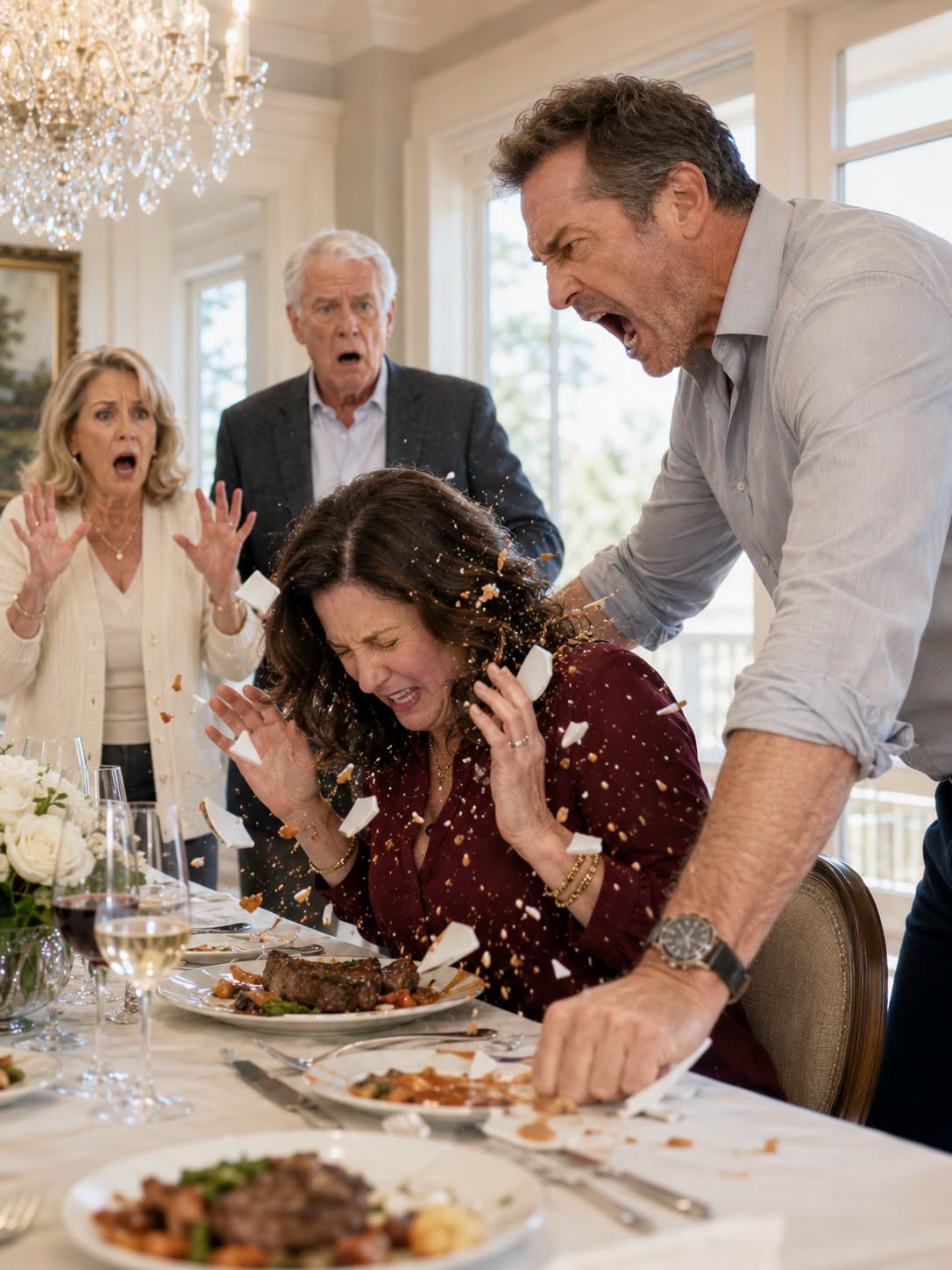
When I refused before the papers appeared, Diego lost control.
“He wasn’t supposed to hit her that hard,” Patrick told investigators.
The sentence reached me through Maya.
Not supposed to hit me that hard.
Which meant he was supposed to frighten me.
The violence had been part of the plan.
Only the severity had been unexpected.
Maya requested that the assault charge be increased and that Diego’s bond be revoked for intimidation.
At the hearing, Diego’s attorneys claimed the threatening roses came from an unknown admirer.
Then prosecutors produced security footage of Diego purchasing the flowers while wearing a baseball cap and sunglasses.
His bond was revoked.
As deputies led him away, he looked toward me.
He did not appear sorry.
He appeared offended that I had refused to stay afraid.
The divorce judge temporarily barred him from accessing the condo, froze the disputed shell-company assets, and prohibited both parties from selling shared property.
Since the condo was never shared, Maya requested immediate confirmation that it remained mine alone.
Diego’s attorney presented the forged quitclaim deed.
Maya presented my travel records, the stolen notary stamp report, Patrick’s cooperation agreement, and an expert analysis identifying traced sections of the signature.
The judge stared at Diego’s attorney.
“Are you knowingly presenting a fraudulent instrument to this court?”
The attorney immediately withdrew the document.
For the first time, the Romero legal machine looked embarrassed.
Outside the courtroom, reporters surrounded me.
I said only one sentence.
“I will speak through evidence.”
That evening, my employer terminated me.
Richard Halston sent a formal letter claiming I had violated confidentiality rules by discussing Aurora Heights with law enforcement.
Maya read it and smiled without humor.
“He just put retaliation in writing.”
Losing my job still hurt.
My career was not only income.
It was the part of my identity I had built before Diego.
But I refused to let Richard’s betrayal erase eleven years of work.
I called three clients personally.
Two expressed sympathy but ended their contracts.
The third, a hospital administrator named Charles Reed, listened quietly.
Then he said, “You were the only architect who told us our original emergency-wing design had evacuation problems. Everyone else wanted the contract. You wanted the building safe.”
“I did my job.”
“That is why we trusted you.”
He paused.
“When this is over, call me.”
Not everyone had been bought.
Not every institution belonged to the Romeros.
Later that night, Sofia arrived with another piece of the past.
She had located a woman named Marisol Vega.
Marisol had dated Diego nine years earlier.
After their relationship ended, she moved to New Mexico and changed her phone number.
“She won’t come to Denver,” Sofia said. “But she agreed to speak by video.”
Marisol appeared on the screen with tired eyes.
“Diego broke my wrist,” she said.
Victoria had paid her hospital bill.
Gabriel paid her landlord to terminate her lease.
They offered ten thousand dollars if she left Colorado.
When she refused, someone planted drugs in her car.
The charges were dismissed after a lab proved the evidence bag had been mishandled, but by then she had lost her job.
“Did Diego ever say why?” Maya asked.
“I owned a small piece of land near one of Gabriel’s developments. They needed it for road access.”
Again, property.
Again, control.
Again, violence against a woman standing between the Romeros and something they wanted.
Marisol leaned toward the camera.
“You need to understand something. Diego thinks love means access. Access to your body, your money, your home, your reputation. When you close a door, he doesn’t think you are setting a boundary. He thinks you are stealing from him.”
After the call ended, I stood alone on my balcony.
Below me, Aurora Heights rose against the night sky.
Cranes hovered above unfinished concrete floors.
If the structure was unsafe, hundreds of future lives could be at risk.
I had spent days thinking the Romeros wanted my apartment.
But the condo was only one piece.
They wanted access through my building.
They wanted my vote.
They wanted my silence about the tower.
And they wanted my professional reputation destroyed before I could warn anyone.
A light suddenly appeared inside Aurora Heights.
Construction had supposedly stopped at sunset.
I watched a figure move across the twenty-fourth floor.
Then another.
May you like
A few seconds later, orange flames rose near the area where project records were stored.
They were burning evidence.
Related Stories