Chapter 8 - THE COURTROOM WHERE HE SMILEDThe video of concrete falling from Aurora Heights appeared on every major network in Colorado.
A twenty-ton section struck the pavement where construction workers usually gathered for their afternoon break.
No one was injured because the city had ordered the evacuation thirty minutes earlier.
Thirty minutes.
That was the distance between scandal and funerals.
Public sympathy shifted overnight.
I was no longer described only as Diego Romero’s bloodied wife.
I became the architect who had warned everyone.
Reporters uncovered emails proving I raised concerns six months before the failure. Richard Halston had responded by telling me to “align my professional judgment with the client’s commercial needs.”
Another email showed Gabriel demanding my removal from the project.
She is becoming emotionally attached to unnecessary safety theories.
Unnecessary safety theories.
The broken concrete in the street answered that claim better than I ever could.
State investigators arrested Richard on suspicion of evidence destruction and commercial bribery.
Gabriel was charged with fraud, obstruction, and reckless endangerment.
Victoria remained free, but her phone, financial accounts, and passport were seized.
Mateo was charged with attempted burglary, intimidation, and domestic violence after Natalie provided her recordings.
Patrick Sloan accepted a cooperation deal.
The Romero family’s polished image did not crumble gradually.
It collapsed like the tower section they had built with cheaper steel.
Yet Diego continued fighting the divorce.
At the first major hearing, he entered the courtroom smiling.
He had been released under electronic monitoring after his attorneys argued that he posed no flight risk.
The smile was deliberate.
He wanted cameras to see confidence.
He wanted investors, relatives, and frightened witnesses to believe the Romeros still controlled the outcome.
Maya leaned toward me.
“Let him smile.”
The hearing concerned ownership of my condominium, temporary support, and legal fees.
Diego demanded that I pay his attorneys.
He claimed unemployment because Romero Development had suspended him.
His lawyers described me as the marriage’s higher earner, ignoring the millions hidden in family trusts.
They also argued that my condo had increased in value during the marriage because Diego contributed “strategic business advice.”
“What advice?” the judge asked.
Diego’s attorney presented photographs of him assembling a bookshelf and choosing dining-room paint.
Maya stared at the attorney.
“Are you requesting equity in a seven-hundred-thousand-dollar property because your client selected beige paint?”
A few people in the courtroom laughed.
The judge did not, but the corners of her mouth moved.
Then Maya presented the financial records.
Every mortgage payment came from my account.
Every renovation invoice carried my name.
Every property-tax payment traced to my earnings.
Diego had contributed nothing.
He had, however, transferred sixty-eight thousand dollars from our joint savings to Capitol Residential Holdings without my knowledge.
He also used twenty-four thousand dollars from the same account to pay Patrick Sloan.
The judge ordered those funds returned to me.
She formally recognized the condo as my separate property.
Diego’s smile vanished.
But Maya was not finished.
She had subpoenaed communications between Diego and Richard.
One message, dated four months before the dinner, read:
V is still refusing the easement. I need you to make her professionally dependent before we push harder.
Richard replied:
Give the firm Aurora Phase Two. She’ll understand what she risks losing.
They had used my career as a leash.
Another message came after I flagged the unsafe steel substitutions.
Diego: She kept copies.
Richard: I can remove her, but you need to control what she has at home.
Diego: I always do.
The courtroom became completely still.
My marriage had been part of their business strategy.
Perhaps Diego once felt something for me.
But by the end, he saw me as an obstacle positioned too close to valuable property and dangerous evidence.
The judge ordered a forensic review of all marital accounts and referred the communications to the criminal investigation.
Diego leaned toward his lawyer, whispering angrily.
His lawyer shook his head.
Then Diego stood without permission.
“This is absurd. She would have nothing without my family.”
The judge looked over her glasses.
“Sit down.”
“She used us!”
“Mr. Romero.”
“She married me for access, and now she is pretending to be a victim because my family asked her to contribute something!”
I remained seated.
Maya had told me not to react.
Diego pointed toward me.
“You think you’re strong because strangers feel sorry for you?”
The bailiff moved closer.
The judge’s voice sharpened.
“One more word, and I will hold you in contempt.”
Diego looked directly at me.
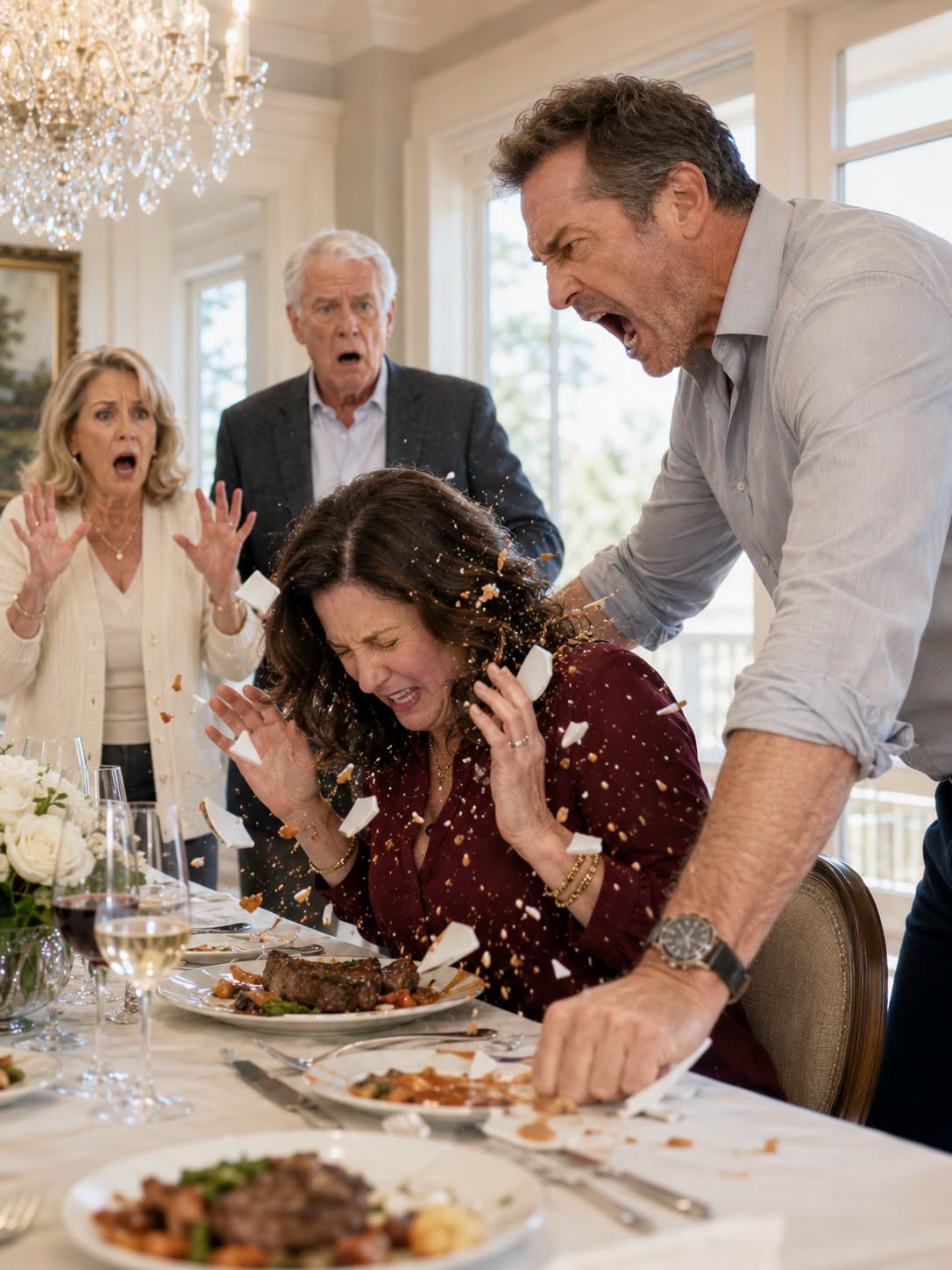
His face was the same face I had seen across the dinner table after the plate broke.
Entitled.
Furious.
Disbelieving that I was still standing.
I wiped no blood away this time.
I simply watched him lose control in front of everyone.
“Take him into custody,” the judge ordered.
The bailiff handcuffed him.
Cameras outside captured him being led through a side corridor.
His famous courtroom smile became the image attached to a headline:
ROMERO HEIR ERUPTS AS WIFE WINS CONTROL OF CONDO.
After the hearing, Natalie met me at a coffee shop near the courthouse.
She had filed for divorce from Mateo.
Her children were staying with her sister under a temporary custody order.
“Victoria sent gifts to their school,” she said.
“What kind of gifts?”
“Tablets, toys, gift cards. Each package had a note saying Grandma will bring you home.”
“Did you tell Maya?”
“Yes. The judge ordered her to stop contacting them.”
Natalie stirred her coffee.
“I keep wondering whether I should have left after the first time Mateo hurt me.”
“You left when you were able to see the situation clearly.”
“My daughter asked why Daddy went to jail.”
“What did you say?”
“That adults have rules too.”
“That sounds right.”
“She asked whether he stopped loving us.”
I waited.
“I told her hurting someone is not love.”
Natalie began crying quietly.
“I wish somebody had told me that when I was seven.”
The criminal investigation continued expanding.
Authorities recovered fragments of the blue ledger from a commercial shredding facility used by Romero Development.
Gabriel’s assistant had delivered six bags of shredded documents after the mansion search began.
Technicians reconstructed enough pages to identify payments to inspectors, bank officers, private investigators, and media contacts.
One payment went to the website that published the first false story about me.
Another went to a clinic administrator who had searched for my medical records.
They found nothing suggesting emotional instability, so the website simply invented it.
A third payment went to Richard Halston.
Eight hundred thousand dollars.
Exactly the amount found in his firm’s consulting account.
Then investigators found a payment made five years earlier to Dr. Samuel Klein.
The private doctor Sofia said had treated her inside the Romero mansion.
Dr. Klein initially denied remembering Sofia.
After prosecutors showed him the ledger, his memory improved.
He admitted treating three women for injuries connected to Diego over nine years.
Sofia.
Marisol.
And someone identified only as E.C.
“Who is E.C.?” I asked Detective Mills.
“We’re trying to determine that.”
Dr. Klein said the woman had suffered broken ribs and a punctured lung.
Victoria paid him fifty thousand dollars in cash.
The woman was taken from the mansion in a private ambulance.
No hospital admission existed under her name.
“Did she survive?” Natalie asked.
“Dr. Klein claims he doesn’t know.”
That evening, a national reporter interviewed Sofia.
She spoke publicly for the first time.
She did not cry.
She did not shout.
She described exactly what Diego had done and exactly how his family covered it up.
At the end, the interviewer asked why she had remained silent for five years.
“Because they convinced me that money made their version of the truth stronger than mine,” Sofia said. “I’m speaking now because another woman refused to stay silent.”
She meant me.
But as I watched, I realized the courage had moved in both directions.
My refusal helped Sofia speak.
Her testimony helped me stand.
Natalie’s honesty helped Lauren return.
Marisol’s story helped investigators recognize the pattern.
The Romeros had isolated women one at a time.
They were losing because we had finally found one another.
The next morning, Detective Mills called.
“We identified E.C.”
Her name was Emily Carter.
She had worked as an interior designer for Romero Development eight years earlier.
She disappeared shortly after the private doctor treated her.
There were no bank records, employment records, or verified addresses after that year.
Police had always assumed she left the country voluntarily.
Now they believed otherwise.
“Are you investigating Diego for her disappearance?” I asked.
“We are investigating everyone.”
That afternoon, workers searching a remote Romero-owned development site found a buried car.
The registration belonged to Emily Carter.
Inside the trunk was a cream-colored silk scarf, a broken phone, and a woman’s identification card.
No body was found.
But beneath the driver’s seat, investigators recovered a gold cuff link engraved with the initials G.R.
May you like

Gabriel Romero.
The man who had calmly stared into his wineglass while his son broke a plate over my head might have been hiding something far worse than fraud.
Related Stories