Chapter 2 – The Man Under the Eucalyptus Tree
Chapter 2 – The Man Under the Eucalyptus Tree
Jessica told me not to look frightened.
That was easier legal advice than human advice.
The gray sedan sat under the eucalyptus tree like a shadow pretending to be parked. Its windshield reflected the streetlights. The driver was only a shape behind the glass, but the phone in his hand caught one flash of light before disappearing.
Jessica stood beside me in the dark kitchen.
“Do you recognize the car?” she asked.
“No.”
“Any relatives in California?”
“No.”
“Any ex-boyfriends? Coworkers? Friends who know your new address?”
“Only the moving company, the realtor, the bank, and my family.”
Jessica’s mouth tightened at the last two words.
My family.
That phrase sounded so harmless until it belonged to the wrong people.
I had spent years defending mine.
Mom is just intense.
Beth is just spoiled.
Dad hates conflict.
Every excuse had been a tiny brick in the wall that kept me trapped. Now I stood in my own house and saw the truth clearly for the first time.
Abuse does not need a stranger’s face.
Sometimes it wears your mother’s perfume.
Jessica stepped away from the window. “I’m calling the non-emergency line.”
“No,” I said too quickly.
She turned.
I heard how scared I sounded, and shame rose in my throat.
“I’m sorry,” I whispered. “I just… police already came here once because of her. I don’t want them thinking I’m unstable.”
Jessica’s expression softened.
“That is exactly why we document everything. People like your mother rely on your fear of looking dramatic.”
The word hit me.
Dramatic.
That was what Linda Simpson called any pain she did not want to acknowledge.
When I cried after Beth cut up my prom dress because she thought the color made me look “prettier than the birthday girl,” I was dramatic.
When I refused to pay Beth’s credit card bill after she bought bridesmaid proposal boxes for women who barely knew her, I was dramatic.
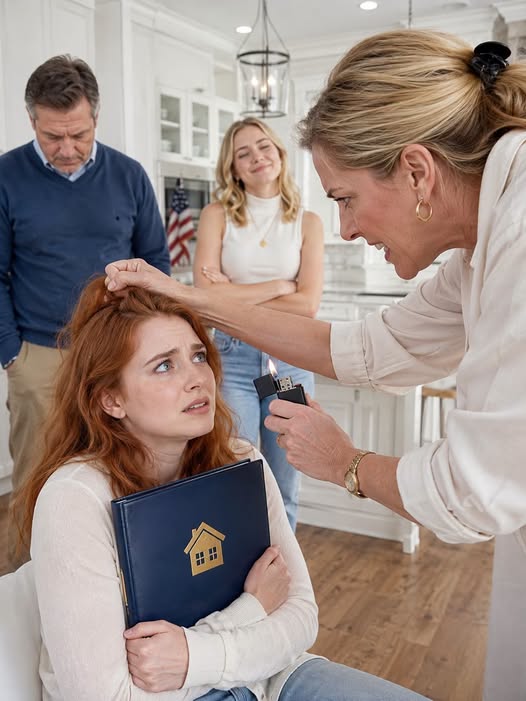
When my mother grabbed my hair and held fire to my cheek, I was apparently still dramatic.
Jessica made the call.
I stood behind her, listening as she gave the dispatcher my address, described the car, explained that I was a recent victim of a false report and suspected financial abuse. Her words were calm and careful. She did not exaggerate. She did not shrink the truth either.
While she spoke, my phone buzzed again.
Unknown number.
I ignored it.
It buzzed again.
Then again.
Jessica glanced over. “Don’t answer.”
The phone stopped.
A voicemail appeared.
Then a text.
Unknown: You shouldn’t have involved outsiders.
My lungs forgot what to do.
I showed Jessica.
She took a screenshot, sent it to herself, and wrote the time down.
The gray sedan’s engine turned over.
It pulled away slowly before the police arrived.
Not fast enough to look panicked.
Not slow enough to look innocent.
Just calmly.
Like whoever sat inside wanted me to know leaving was a choice.
Twenty minutes later, Officer Martinez stood on my porch with his partner, Officer Bell. They were different officers from the night before, but they had already read the report. That alone made me feel less insane.
Officer Martinez was in his forties, with tired eyes and a voice that sounded like he had seen every version of family cruelty and still hated it.
“We’ll add the suspicious vehicle and message to the incident log,” he said.
“Can you trace the number?” I asked.
“Sometimes. But people use apps, burner phones. Still worth documenting.”
Officer Bell looked past me into the empty house. “You just moved in?”
“Two weeks ago.”
Her face changed slightly.
Not pity.
Recognition.
Women recognize certain stories before they are fully told.
“Do you have security cameras?” she asked.
“Not yet.”
“Get them tomorrow.”
Jessica answered before I could. “We will.”
Officer Martinez gave me a card with a case number.
Case number.
Those two words made my life feel both safer and more terrifying.
Because now it was real enough for paperwork.
After they left, Jessica stayed another hour. She called my bank’s fraud department, helped me freeze the compromised account, and opened a new one with restrictions so severe I had to answer security questions that made me feel like I was applying to guard a nuclear facility.
Then she contacted Phoenix police.
I listened from across the kitchen while she used phrases that sounded heavy and official.
False report.
Unauthorized financial access.
Interstate harassment.
Threat involving an open flame.
Possible conspiracy.
Conspiracy.
That word made me flinch.
It sounded too large for my family.
Too criminal.
Too dramatic.
Then I remembered Beth’s text.
You better fix this before Mom does something permanent.
After Jessica left, I walked through my house turning on every light.
The living room.
The kitchen.
The hallway.
The bathroom with one towel hanging crookedly from the rod.
The bedroom where my mattress sat on the floor beneath a window facing the side yard.
Every room looked harmless in the light.
But I could still feel watched.
At 1:13 a.m., I gave up pretending to sleep.
I made coffee in a saucepan because I had not unpacked my coffee maker yet. Then I sat on the floor with my laptop and searched for security cameras, doorbell systems, fraud recovery steps, and restraining orders in California.
At 2:07 a.m., an email arrived.
Subject: Final Notice – Wedding Balance
I did not recognize the sender at first.
Then I saw the signature.
Camellia House Events
Scottsdale, Arizona
Beth’s wedding venue.
My stomach twisted.
The email was addressed to me.
Dear Ms. Simpson,
As discussed with Mrs. Linda Simpson, your payment method has been used toward the remaining balance for the Mason-Simpson wedding scheduled for October 18. Unfortunately, the most recent installment was declined. Please update your payment information within 48 hours to avoid disruption to the event.
I read it three times.
My payment method.
As discussed with Mrs. Linda Simpson.
Mason-Simpson wedding.
I had never spoken to Camellia House Events.
I did not know Beth’s fiancé’s last name was Mason until that moment.
The room tilted slightly.
There were attachments.
Invoice.
Payment schedule.
Contract addendum.
I opened the contract with shaking hands.
Near the bottom, under Responsible Party, was my name.
Joanna Marie Simpson.
My address was old.
My phone number was correct.
My signature was not.
But someone had tried.
A crooked, ugly imitation of my handwriting stretched across the line.
I covered my mouth.
It was not just bank fraud.
My mother had put my name on Beth’s wedding contract.
She had not wanted me to contribute.
She had wanted me legally responsible.
The next morning, Jessica arrived with two coffees, a packet of legal forms, and the expression of someone who had not slept much either.
I showed her the email.
She read it once.
Then again.
Then she said, “Joanna, this is worse than we thought.”
I almost laughed.
Not because it was funny.
Because I wondered how many times a person could hear that sentence before the body stopped reacting.
Jessica pointed to the signature.
“This is forgery.”
I nodded.
“And if the venue believed you were the responsible party, your mother may have used your identity to secure services.”
“Identity theft?”
“Yes.”
The word landed like a door closing.
I thought of my mother at the kitchen sink.
My father behind the newspaper.
Beth smiling from the hallway.
“You’re not even married.”
“That money was for your sister’s wedding.”
Not a tantrum.
Not disappointment.
A plan.
A long one.
Jessica called Camellia House on speaker.
A woman named Melanie answered with the bright, polished voice of someone trained to keep brides calm and vendors paid.
When Jessica introduced herself as my attorney, the brightness faded.
“We were told Ms. Simpson authorized Mrs. Linda Simpson to coordinate payments,” Melanie said carefully.
“I did not,” I said.
Silence.
Then Melanie asked, “You’re saying you did not sign the responsible-party agreement?”
“I’m saying I’ve never seen it before this morning.”
More silence.
Then paper rustling.
Melanie lowered her voice. “Ms. Simpson, your mother provided a copy of your driver’s license.”
The coffee turned sour in my stomach.
Jessica’s eyes snapped to mine.
“My driver’s license?” I whispered.
“Yes,” Melanie said. “A scanned copy.”
I knew exactly where it came from.
Three years earlier, my mother had asked for a copy of my license “for emergency family records” before we flew to Denver for my cousin’s funeral. I had sent it without thinking.
Because back then, I still believed mothers collected information to protect their children.
Not to impersonate them.
Jessica asked Melanie to preserve all documents, emails, call logs, and payment records.
Melanie agreed too quickly.
She knew.
Maybe not everything.
But enough.
Before the call ended, Melanie hesitated.
“There is one more thing,” she said. “Mrs. Simpson called yesterday. She was very upset. She said if payment was not restored, the venue should expect legal trouble from you.”
“From me?” I asked.
“Yes,” Melanie said. “She said you were emotionally unstable and might try to sabotage the wedding.”
Jessica closed her eyes for one second.
When she opened them, they were colder.
“Please send everything,” she said.
After the call, I walked outside because I suddenly could not breathe inside my own house.
The morning air in Monterey smelled like salt and damp grass. A gull cried somewhere overhead. Across the street, the eucalyptus tree moved gently in the wind, empty now except for sunlight.
I wanted to believe that meant the danger had passed.
Then a delivery van pulled up.
The driver stepped out holding a padded envelope.
“Joanna Simpson?” he asked.
I signed.
The return address was Phoenix.
No name.
Only a P.O. box.
Jessica stood behind me in the doorway as I opened it.
Inside was my old blue notebook.
The one with my passwords.
The one I thought I had lost.
Most of the pages had been torn out.
Only one remained.
Across it, in my mother’s handwriting, were six words.
You should have just paid quietly.
Beneath the note was a photograph.
My new house.
May you like

Taken from across the street.
At night.