Chapter 9 – The Drawer in My Old Bedroom
Chapter 9 – The Drawer in My Old Bedroom
I did not fly to Phoenix for the search.
For once, I refused to return to the scene of my own shrinking.
Jessica handled communication through attorneys and law enforcement. My father cooperated. My mother, according to everyone, alternated between sobbing victimhood and volcanic rage.
Beth disappeared from social media.
That told me she had finally hired a lawyer.
It should have been peaceful, waiting in Monterey while the truth surfaced in Arizona.
It wasn’t.
Every drawer they opened in that house opened something inside me too.
At 10:18 a.m., Jessica called.
“They found more.”
I stood in my living room, where a real couch had finally arrived that morning. The delivery men had just left. The couch was still wrapped in plastic, absurdly normal in the middle of disaster.
“What more?”
“In your old bedroom.”
I sat down on the plastic.
It crackled beneath me.
“My old bedroom?”
“Yes. The closet.”
When I left Phoenix years earlier, my mother turned my bedroom into what she called a “family storage room.” I had not been allowed to object. The room no longer belonged to me, she said. I had moved out. Beth still had half a closet there, naturally, because Beth liked to keep seasonal dresses where other people’s memories used to be.
“What was in the closet?” I asked.
“A file cabinet.”
I closed my eyes.
Of course.
Of course my mother would bury stolen versions of me in the room where I first learned to become useful.
Jessica continued carefully.
“There were folders with your name, Beth’s name, your father’s name, and several credit applications. Some completed. Some not. They also found old mail, copied signatures, password notes, and what appears to be a practice sheet.”
“A practice sheet?”
“For your signature.”
I leaned forward, elbows on knees.
The room blurred around me.
A practice sheet.
I pictured my mother at the kitchen table, copying my name over and over.
Joanna Simpson.
Joanna Simpson.
Joanna Simpson.
Not writing to me.
Becoming me.
Long enough to spend me.
“There’s another folder,” Jessica said.
Her voice had changed.
“What?”
“Labeled Contingency.”
The word made my skin crawl.
“What was in it?”
“Draft letters.”
“To who?”
“Your employer. Your mortgage lender. Your realtor. A few neighbors in Monterey, though it doesn’t look like she had names yet.”
“What did the letters say?”
Jessica hesitated.
“Joanna.”
“Tell me.”
“They accuse you of financial instability, elder abuse, theft, mental health concerns, and abandoning family obligations.”
I laughed once.
It came out like a cough.
“She was going to poison everything.”
“Yes,” Jessica said softly. “If intimidation failed.”
The letters were never sent.
That fact should have comforted me.
It did not.
Unsent cruelty is still cruelty.
It only lacks postage.
By noon, Phoenix police had enough to escalate the investigation. The bank’s fraud department confirmed documents had been submitted electronically using an IP address tied to my parents’ home. The venue produced emails from Linda and Beth discussing payment timing. Tyler Mason’s statement placed Beth at the center of the intimidation attempt, though he was still trying to minimize himself.
The case was no longer a family dispute.
It had become a structure.
Fraud.
Forgery.
Identity theft.
Harassment.
Threats.
Attempted coercion.
Every word sounded too official for the woman who used to cut the crusts off my sandwiches.
That was the part nobody warns you about.
When an abuser is exposed, you do not only grieve what they did.
You grieve every ordinary moment that now looks different under the light.
Was she thinking about my credit when she hugged me at Christmas?
Was she planning the loan when she asked about my salary?
Was she already copying my signature when she told the neighbor I was “the dependable daughter”?
That evening, Beth finally called Jessica’s office.
Not me.
Never me.
She wanted a deal.
Jessica called it “early positioning.”
Mrs. Alvarez called it “rats leaving a wet basement.”
Beth claimed she had been manipulated by Linda. She claimed she believed I had agreed to help. She claimed Tyler acted independently. She claimed the group chat was “taken out of context.” She claimed she was emotionally abused too.
Some of that may have been true.
That was the most inconvenient part.
Beth had been shaped by the same mother.
But being harmed does not give you the right to become a weapon in someone else’s hand.
Jessica asked what I wanted.
That question followed me into the night.
What did I want?
Money back, yes.
Credit restored, absolutely.
Legal protection, urgently.
But beneath all that was something harder to name.
I wanted my life to stop being a community account.
I wanted my name back.
The next morning, a hearing was scheduled in California for a longer protective order. Linda’s attorney argued by phone that she had never directly threatened me in Monterey and that family financial disagreements had been exaggerated.
Then Jessica played the voicemail.
Not the full thing.
Only my mother’s sentence.
You are coming back to Phoenix, Joanna. One way or another.
The courtroom went very still.
Then Jessica presented the photograph of my house.
The gas can footage.
The forged contract.
The text from Beth.
You better fix this before Mom does something permanent.
The judge did not look entertained.
Some people mistake courtrooms for theaters because they have seen too much television.
Real courtrooms are worse.
No music.
No dramatic zoom.
Just fluorescent lights, paper, and consequences.
The protective order was granted.
Linda Simpson was prohibited from contacting me, approaching my home, directing others to contact me, or using my personal information in any capacity.
Beth was included under separate harassment restrictions pending investigation.
Tyler Mason was ordered to stay away from me and my property.
For the first time, the law drew a line my family had never respected.
I walked out of the courthouse feeling lighter.
Not free.
But less hunted.
In the parking lot, my phone buzzed.
Unknown number.
My heart kicked.
I showed Jessica before opening it.
This time, it was a photo.
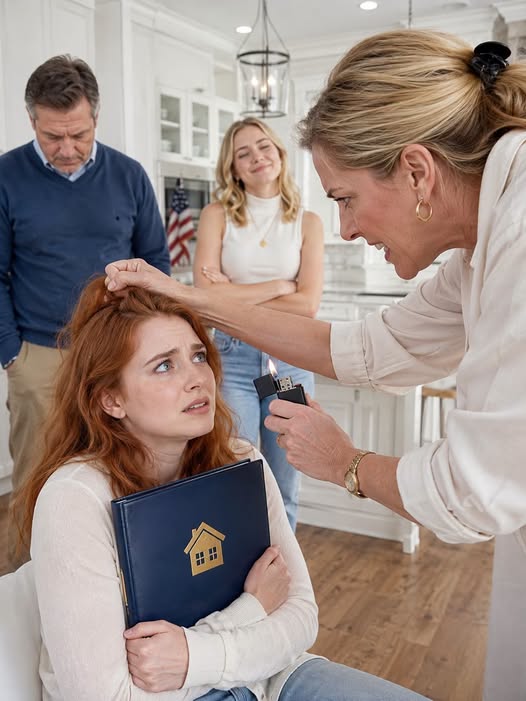
A woman’s hand holding a lighter.
My mother’s hand.
The message read:
Court orders burn too.
Jessica immediately called the police.
But I stared at the image, and something bothered me.
The background.
It was not my parents’ house.
Not Beth’s apartment.
Not anywhere in Phoenix I recognized.
Behind the lighter was a motel bedspread.
Orange and brown.
Ugly floral pattern.
Jessica sent the image to investigators.
Within hours, they traced enough metadata to identify a location.
A motel in Salinas.
Thirty minutes from Monterey.
My mother had violated the protective order the same day it was issued.
She was in California.
Not coming.
Already here.
Police moved fast.
But Linda Simpson had survived decades by sensing doors closing before they shut.
By the time officers reached the motel, she was gone.
In the room, they found an overnight bag, a half-empty bottle of wine, printed maps of my neighborhood, and three photographs of my house.
On the desk was a final note.
Not mailed.
Not hidden.
Placed neatly where police would find it.
My daughter belongs to me.
Jessica read it aloud over the phone.
I did not cry.
I did not shake.
I walked to my front door and looked out at the porch where gasoline had darkened the concrete days earlier.
Then I did something my mother would never have expected.
I turned on every exterior light.
The porch.
The side yard.
The garage.
The back patio.
May you like

My little house lit up against the Monterey night like it refused to be ashamed.
And somewhere out there, Linda Simpson was watching a daughter she could no longer keep in the dark.