Chapter 5 – The Bride Who Knew Too Late
Chapter 5 – The Bride Who Knew Too Late
Connor did not yell.
Somehow, that made Beth more afraid.
He stood in my entryway with the phone in his hand, jaw tight, eyes fixed on nothing. Eleanor hovered near the threshold like a general watching a battlefield collapse. Jessica remained beside the kitchen island, documenting every word.
Beth’s breathing came through the speaker in ragged bursts.
“Connor,” she said, “please don’t do this over the phone.”
“Answer me.”
“I said not at first.”
“That is not an answer.”
“It is!”
“No,” he said. “It’s a delay.”
I almost flinched.
I had never heard someone talk to Beth that way.
Not cruelly.
Clearly.
Beth knew how to survive around anger. She cried, softened, redirected, performed injury. But clarity gave her nowhere to hide.
“When did you know?” Connor asked.
Silence.
Eleanor stepped forward. “Connor, this is humiliating.”
He did not look at her.
“When, Beth?”
My sister whispered, “After the first vendor payment.”
The room seemed to contract.
Jessica’s pen moved quickly.
Connor’s voice lowered. “How many payments ago was that?”
Beth cried harder.
“How many?”
“I don’t know.”
“Yes, you do.”
“Four,” she said.
Jessica looked at me.
Four.
Four separate moments when my sister could have stopped it.
Four moments when she chose flowers, catering, linens, and a string quartet over my life savings.
Connor turned away, pressing the heel of his hand into his eye.
“Did you know Joanna’s signature was forged?”
“No.”
“Beth.”
“I didn’t ask!”
That confession cracked louder than the first.
She did not know because she chose not to know.
A beautiful kind of ignorance.
The expensive kind.
The kind that gets preserved under soft lighting and called stress.
“I thought Mom handled it,” Beth said. “She said Joanna had always been difficult with money. She said Joanna would deny it later because she likes being a martyr.”
I laughed softly.
I did not mean to.
Everyone turned toward me.
“I’m sorry,” I said. “It’s just amazing how theft somehow becomes my personality flaw.”
Beth heard me.
Her voice sharpened immediately.
“You don’t know what it’s like, Joanna.”
I stared at the phone.
“What what is like?”
“To be the one people expect things from.”
For a second, I thought I had misheard her.
Then I realized Beth truly believed it.
She believed being admired was pressure.
She believed being celebrated was labor.
She believed my job had always been to finance the stage beneath her feet.
“You’re right,” I said. “I don’t know what it’s like to expect things from people and call it suffering.”
Beth made a wounded sound.
Connor looked sick.
Eleanor finally lost patience.
“Enough,” she snapped. “This conversation is helping no one.”
Jessica spoke without looking up. “It’s helping my client.”
Eleanor’s eyes flashed.
“Your client is destroying two families.”
“No,” Jessica said. “Fraud did that.”
Beth sobbed, “Joanna, please. I can’t lose Connor.”
Something in me hurt then.
Not enough to save her.
But enough to remember.
Once, Beth had been six years old, standing in our backyard after falling off a swing. I had run to her before Mom did. I had cleaned dirt from her knee with my T-shirt while she cried into my shoulder. Before our mother taught us our roles, Beth had just been my little sister.
Then Linda Simpson got hold of us.
She made one daughter responsible.
The other precious.
And both of us damaged.
“Beth,” I said quietly, “you need to tell the truth to the police.”
“No.”
“Then this gets worse.”
“It’s already worse!”
“No,” Jessica said. “It isn’t.”
The bluntness stunned everyone.
Jessica closed her folder.
“It can become criminal charges, civil damages, vendor lawsuits, credit disputes, restraining orders, and possibly charges related to intimidation depending on who was outside Joanna’s house.”
Beth stopped crying.
Connor turned slowly.
“Outside her house?”
I told him about the gray sedan.
The photograph.
The notebook.
The text from Beth.
You better fix this before Mom does something permanent.
Connor looked at the phone in his hand like it had become poisonous.
“Beth,” he said, “did you know someone came to Monterey?”
“No.”
That answer sounded real.
For once.
“What does ‘something permanent’ mean?”
“I don’t know! Mom was upset. She says things.”
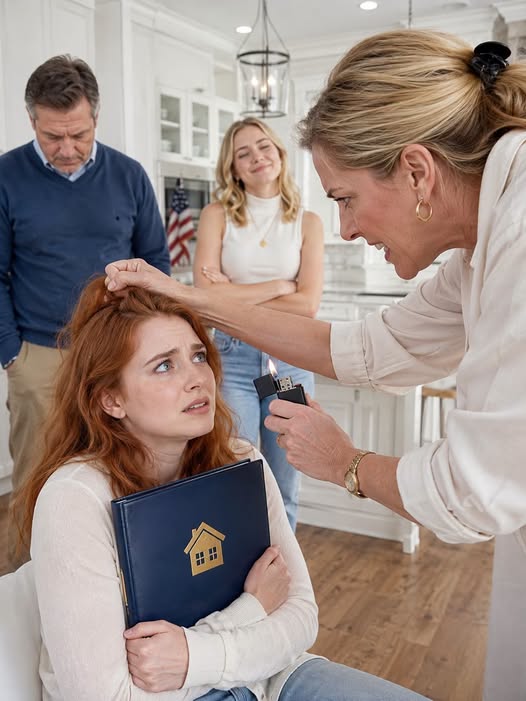
“She held a lighter to Joanna’s face,” Connor said.
Beth did not answer.
He looked at me.
That silence told him everything.
Eleanor’s face shifted again. There was finally fear there, but not for me.
For Connor.
For the family name.
For deposits.
For speeches.
For the wedding announcement in the Scottsdale society magazine.
Connor ended the call without saying goodbye.
Beth called back immediately.
He declined.
Again.
Declined.
Again.
This time, he powered off the phone.
Eleanor whispered, “Connor.”
He looked at his mother.
“I’m going back to Phoenix.”
“Good,” she said quickly. “We need to manage this before—”
“I’m going to talk to my attorney.”
Her mouth closed.
“And Beth,” he continued. “Alone.”
“Connor, don’t make emotional decisions.”
He looked around my empty house.
At the boxes.
At the documents.
At the woman his future family had tried to ruin because she bought a roof with her own paycheck.
“I think the emotional decision was ignoring every red flag because the wedding photos looked good.”
Eleanor’s eyes filled with offended tears.
I had seen that expression before.
Different face.
Same tactic.
Connor was gentler than I would have been.
“Mom, wait in the car.”
She did not move.
“Please,” he said.
That please cost him something.
Eleanor left.
The front door closed behind her with a controlled click.
Connor stood in silence for a moment, then said, “I’m sorry.”
“You already said that.”
“Not enough.”
I looked away.
Apologies were strange when they came from the wrong person. Connor had not stolen from me. He had not forged my name. He had not sent police to my door.
But he was the first person connected to the wedding who seemed willing to admit I had been harmed.
That made his apology heavier than it should have been.
“Did Beth love you?” I asked.
The question surprised him.
He gave a tired, humorless smile.
“I thought so.”
“Maybe she does.”
He looked at me.
“Love doesn’t make people honest,” I said. “Sometimes it only makes them afraid to lose what lying got them.”
Connor absorbed that.
Then he nodded.
Before leaving, he gave Jessica his contact information and promised to preserve all messages from Beth and Linda. Jessica advised him not to discuss details without counsel. He agreed.
At the door, he paused.
“Your mother told my parents you were unstable,” he said.
“I know.”
“She said you had always resented Beth because you were alone.”
I looked past him at the porch.
My porch.
My cracked light.
My little square of California.
“Being alone was never the problem,” I said. “Being owned was.”
Connor’s face softened.
Then he left.
His rental car disappeared down the street with Eleanor in the passenger seat, already leaning toward him, already talking.
I watched until they turned the corner.
Then I closed the door and locked it.
Jessica stayed with me another two hours.
She filed emergency documentation, contacted a fraud investigator, sent preservation notices to the venue and vendors, and helped me order cameras for every corner of the house.
By evening, I was too exhausted to stand.
I sat on the floor beside the mattress and opened a can of soup because my pots were still packed somewhere under “miscellaneous.”
At 9:42 p.m., my father called.
For a long time, I just stared at his name.
Dad.
The man who had whispered “My goodness” while my mother held fire to my face.
The man who stayed seated.
I almost let it ring.
Then I answered.
“Joanna,” he said.
His voice sounded older than it had two weeks ago.
“What do you want?”
He breathed shakily.
“I need to tell you something before your mother finds out I called.”
My body went still.
Behind his voice, I heard a muffled sound.
A door closing.
Then his whisper.
“Beth isn’t the only one your mother used your name for.”
I gripped the phone.
“What does that mean?”
He swallowed.
“There’s a loan.”
The room tilted.
“What loan?”
My father began to cry.
And for the first time in my life, his tears did not move me.
May you like

They warned me.
“Joanna,” he whispered, “your mother put your name on the house.”